
Statistical portrait of francophone arts and culture in Alberta
Highlights of existing studies

This article summarizes existing research into French-language arts and culture in Alberta and was prepared at the request of the Alberta Foundation for the Arts. Hill Strategies retained analytical independence and editorial control of the content.
The article reviews research related to six topics: the economic impact of francophone culture, French-speaking cultural workers, French-speaking artists, French-speaking arts leaders, arts participation in French, and access to francophone arts and culture.
This article largely relies on published reports, some of which are my own articles. New analysis of unpublished data is also included in this article.
Economic impact of francophone culture
In December of 2025, I published an analysis of the economic impact of arts, culture, and heritage of the French-Canadian cultural community in 2023. The study used Statistics Canada’s census definition of linguistic minorities, which includes Alberta residents who might request federal communications and services in French (because their mother tongue is French or because they speak French relatively frequently at home). The key findings for Alberta are reproduced in this section.
The analysis was based on Statistics Canada’s provincial and territorial cultural indicators, 2021 census, and input-output multipliers (which reflect the interrelatedness of specific industries, based on Statistics Canada’s economic measurements).
Total revenues from francophone cultural production in Alberta amounted to $337 million in 2023.
The net impact of francophone arts, culture, and heritage on Alberta’s GDP was $296 million in 2023. As shown in the following graph, this includes:
A direct impact of $190 million.
An indirect impact of $65.9 million.
An induced impact of $40.1 million.
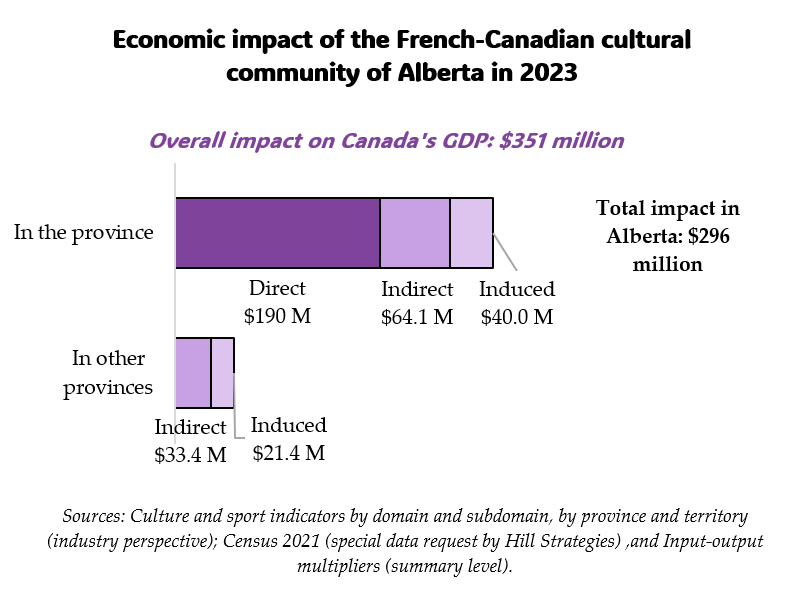
Franco-Albertan cultural activity also had a $55 million impact on the GDP of other Canadian provinces, resulting in a Canada-wide impact of $351 million.
Cultural workers
The sections of this article related to workers in the arts, culture, and heritage use Statistics Canada’s census definition of linguistic minorities, which includes Alberta residents who might request federal communications and services in French (because their mother tongue is French or because they speak French relatively frequently at home).
In Alberta, 2,600 cultural workers speak French, representing 3.7% of all francophone workers in the province. The concentration of cultural workers is slightly higher than that for all Alberta workers, regardless of language (3.3%).
Francophone cultural workers represent 3.2% of all cultural workers in the province, slightly higher than French-speakers’ share of all workers (2.9%).
Never-before-published demographic data indicate that, of the 2,600 francophone cultural workers in Alberta:
64% are women (higher than the percentage among anglophone cultural workers: 58%)
16% are racialized (lower than the percentage among anglophone cultural workers: 21%)
4.3% are Indigenous (similar to the percentage among anglophone cultural workers: 4.5%)
18% are 55 years of age or older (lower than the percentage among anglophone cultural workers: 22%)
42% have a bachelor’s degree or higher (lower than the percentage among anglophone cultural workers: 51%)
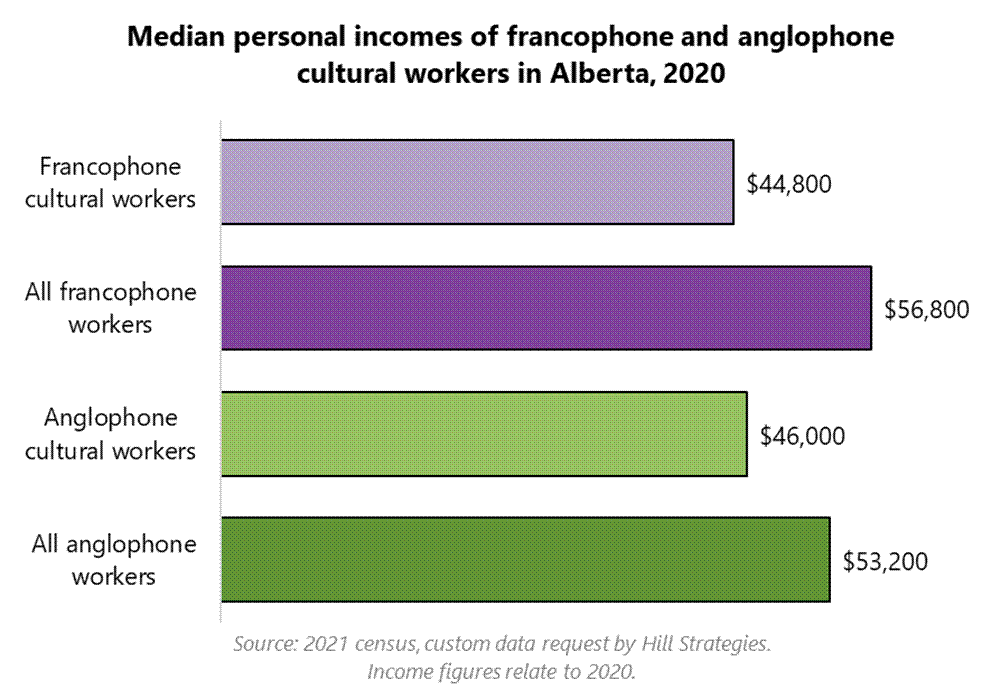
In Alberta, francophone cultural workers had a median personal income of $44,800 in 2020. This is 3% lower than the median income of anglophone cultural workers in the province ($46,000).
Relatively to all francophone workers in the province ($56,800), the median income of francophone cultural workers is 21% lower ($44,800). These income statistics are depicted in the following graph.
Note: Fifty-two occupation groups are included as cultural workers, including artists, arts leaders, plus a range of other occupations in the performing arts, sound recording, film, video, broadcasting, libraries, archives, galleries, museums, other heritage institutions, architecture, design, publishing and printing. Further details about the occupation groups are available at the end of this article.
Artists
There are 630 francophone professional artists in Alberta (who work more as an artist than at any other occupation). This represents 0.9% of all francophone workers in the province, a proportion that is slightly higher than French-speakers’ share of all Alberta workers, regardless of language (0.7%).
Francophone artists account for 3.4% of all artists in the province, higher than French-speakers’ share of all workers (2.9%).
Unpublished demographic data show that, of the 630 francophone artists in Alberta:
67% are women (higher than the percentage among anglophone artists: 62%)
14% are racialized (lower than the percentage among anglophone artists: 17%)
5.6% are Indigenous (similar to the percentage among anglophone artists: 5.9%)
22% are 55 years of age or older (lower than the percentage among anglophone artists: 26%)
58% have a bachelor’s degree or higher (higher than the percentage among anglophone artists: 39%)
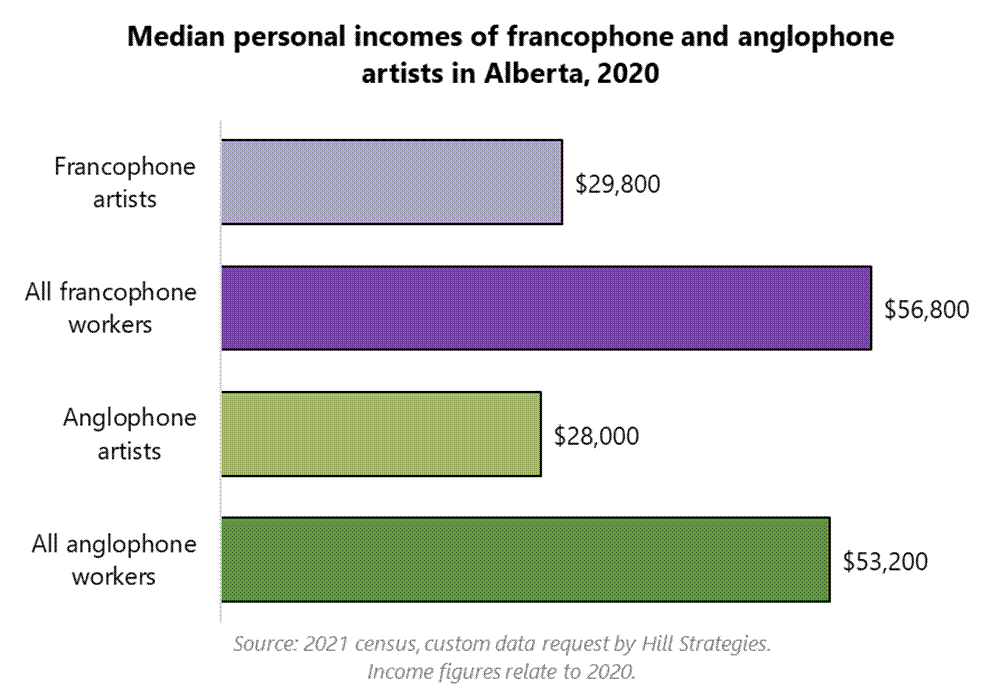
French-speaking artists in Alberta had a median personal income of $29,800 in 2020, which is 6% higher than the median income of anglophone artists in the province ($28,000).
However, the median income of francophone artists is 48% lower than the median income of all francophone workers in the province (i.e., $29,800 vs. $56,800). These key income statistics are presented in the following graph.
Note: A broad range of artists are included in the above statistics, including visual artists, artisans, craftspeople, photographers, writers, musicians, actors, comedians, circus performers, dancers, conductors, composers, producers, directors, choreographers, and other performers. Further details about the artist occupation groups are available at the end of this article.
Arts leaders
110 French-speaking Albertans work in five occupation groups that are classified as arts leaders. Francophones represent 3.1% of all arts leaders in the province, higher than French-speakers’ share of all workers (2.9%). Demographic breakdowns and income statistics are not provided here because of the relatively small number of francophone arts leaders.
Arts participation in French
A Statistics Canada survey in 2022 of Canadians in minority-language situations provides insights into French-language arts participation. In its presentation of the survey results, Statistics Canada grouped the four western provinces, likely due to concerns over data reliability in each province.
The survey found that, in the western provinces:
23% of francophone adults and 25% of francophone children had attended at least one French-language performance or arts event during the 12 months preceding the survey.
19% of French-speaking children read books in French as often or more often as books in English. The other 81% of French-speaking children read books in English more often than in French.
Access to francophone arts and culture
A survey of Francophones and Francophiles outside of Quebec conducted for the Fédération culturelle canadienne-française probed respondents’ beliefs regarding the availability and importance of minority-language cultural offerings. Specific findings, which unfortunately cannot be broken down by province, include:
50% are satisfied with the current range of francophone arts and cultural offerings in their region.
Less than one-half believe that they have easy access to francophone artists and cultural groups in their community (45%) or that they are lucky enough to have the opportunity to visit cultural venues offering French-language programs near their home (39%). Similarly, 30% believe that there are not enough French-language cultural services in their region.
65% believe that access to arts and culture in French is an important challenge that must be addressed in francophone minority communities in coming years.
A Statistics Canada survey of businesses and organizations in the arts, heritage, and entertainment industries found that 8% of Alberta-based cultural businesses and organizations offer French on their website and 7% offer French-language customer service.
Occupation groups included in the labour force statistics
Statistics Canada’s full occupation titles for the 10 occupation groups included as artists are:
Actors, comedians, and circus performers
Artisans and craftspersons
Authors and writers (excluding technical writers)
Conductors, composers, and arrangers
Dancers
Musicians and singers
Other performers (including buskers, DJs, puppeteers, face painters, erotic dancers, and many other entertainers)
Painters, sculptors, and other visual artists
Photographers
Producers, directors, choreographers, and related occupations
The five arts leadership occupations are:
Conductors, composers, and arrangers
Conservators and curators
Library, archive, museum, and art gallery managers
Managers in publishing, motion pictures, broadcasting, and the performing arts
Producers, directors, choreographers, and related occupations
The statistics on cultural workers include people who work in 52 occupation groups in the arts, culture, and heritage. I have also outlined the methods behind choosing the 52 occupation groups, as well as some strengths and limitations of the census for counting artists and cultural workers.
Census estimates are based on the job at which a person worked the most hours during the reference week in May of 2021. For all occupation groups, people are counted in industries across the economy, not just in cultural organizations or businesses (as long as they are classified into one of the selected occupation groups).