
Economic impact of the French-Canadian cultural community outside Quebec in 2023
Over $6 billion in estimated impact on Gross Domestic Product

This report provides updated estimates of the economic impact of arts, culture, and heritage of the French-Canadian cultural community in 2023 for Canada, provinces outside Quebec, and the three territories. The analysis is based on three Statistics Canada products: provincial and territorial cultural indicators, the 2021 census, and input-output multipliers.
The estimate of the impact on Gross Domestic Product (GDP) represents the economic value added of Francophone cultural activity. GDP, a measure of net economic performance, is by far the most common economic indicator. The total impact on GDP is the sum of direct, indirect and induced impacts:
Direct impacts represent the value added to GDP by spending in the cultural sector. These estimates come directly from Statistics Canada.
Indirect impacts represent the value added to GDP by suppliers to cultural organizations, businesses, and individuals. The indirect calculations were performed by Hill Strategies, based on Statistics Canada multipliers.
Induced impacts represent the value added to GDP from the salaries of cultural staff and supplier staff. As with indirect impacts, Hill Strategies performed these calculations based on Statistics Canada multipliers.
In each province, a portion of indirect and induced cultural spending (and therefore cultural GDP) occurs in other provinces. This report provides two estimates of the impact on GDP: the impact within the province and the total impact across the country.
In addition to the net impact on GDP, the report presents two other economic indicators resulting from French-Canadian cultural activity:
Production is a measure of gross economic activity, corresponding to total revenues (with some adjustments, e.g., imputed values for free cultural activities). For ease of understanding, this report refers to this indicator as “total revenues”. These estimates come directly from Statistics Canada. The impact on GDP (net value) is calculated from total revenues (gross value).
The number of Francophones working in culture outside Quebec is taken from previous analyses by Hill Strategies, based on a census data request. The percentage of Francophones in each province is essential to our estimates of Francophone GDP. Statistics Canada does not break down its cultural indicators by language, but Hill Strategies’ special data request from the 2021 census made this calculation possible.
In general, the analysis is detailed and rigorous, while remaining practical. It is based on the share of Francophones in cultural professions, rather than on surveys specific to the cultural sector, which would require extensive resources. More details on the methods can be found in the notes at the end of this report.

National results
Total revenues from Francophone cultural production outside Quebec amounted to $5.82 billion in 2023, an increase of 9% from the estimate of $5.32 billion in 2021 (not adjusted for inflation). The estimate of cultural revenues serves as the basis for estimates of the impact on GDP.
In 2023, the GDP impact of Francophone arts, culture, and heritage (outside Quebec) amounted to $6.15 billion.
As shown in the first graph, this estimate includes:
A direct impact of $3.12 billion.
An indirect impact of $1.79 billion.
An induced impact of $1.24 billion.
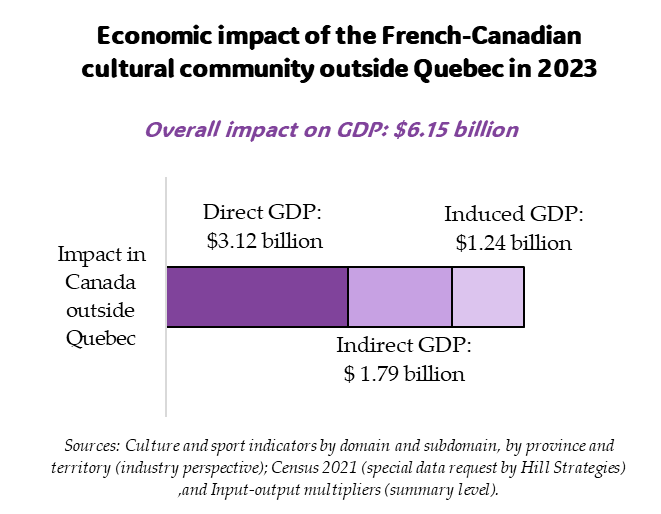
The total impact on GDP in 2023 ($6.15 billion) represents a 9% increase over 2021 ($5.63 billion).
According to the 2021 census, 36,100 cultural workers outside Quebec speak French, representing 5.2% of all cultural workers Quebec. We used this proportion (and the proportions in each province) to estimate the GDP of Francophone cultural activity.
Provincial results
Newfoundland and Labrador
The impact of Francophone arts, culture, and heritage on Newfoundland and Labrador’s GDP was $16.6 million in 2023. In addition, the impact was $3.7 million in other Canadian provinces, for a Canada-wide impact of $20.4 million. The impact on Canadian GDP represents an 11% increase over 2021 ($18.4 million).
The estimated impact in NL includes:
A direct impact of $11.6 million.
An indirect impact of $3.4 million.
An induced impact of $1.7 million.
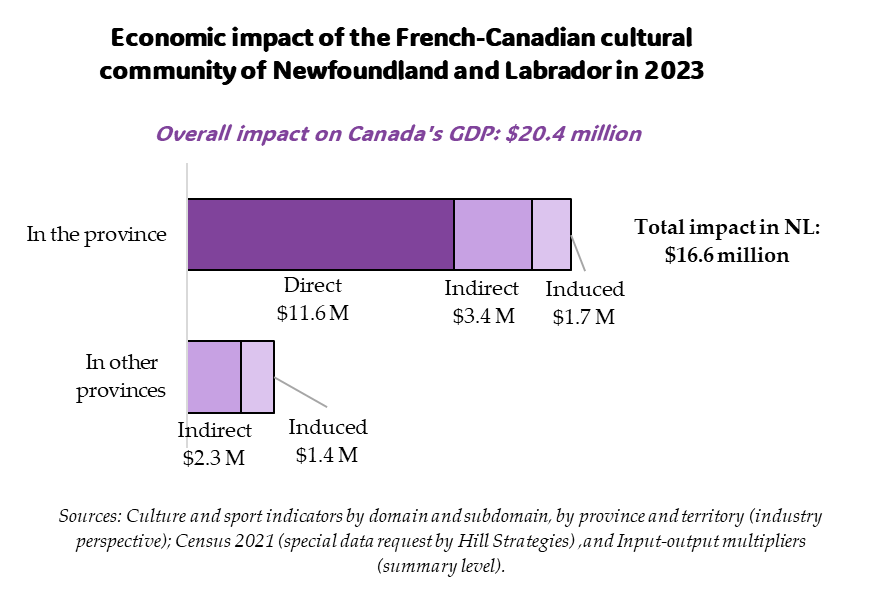
Revenues from Francophone cultural production in Newfoundland and Labrador totalled $19.6 million.
In the province, 150 Francophones work in culture, representing 2.2% of the province’s cultural workers, according to an analysis of the census by Hill Strategies.
Prince Edward Island
The impact of Francophone arts, culture, and heritage on Prince Edward Island’s GDP was $21.5 million in 2023. Added to this figure is an impact of $5.5 million in other Canadian provinces, for a total impact of $27.0 million across Canada. The impact on Canadian GDP increased by 13% between 2021 ($23.9 million) and 2023.
The estimated impact in PEI in 2023 includes:
A direct impact of $15.9 million.
An indirect impact of $3.4 million.
An induced impact of $2.3 million.
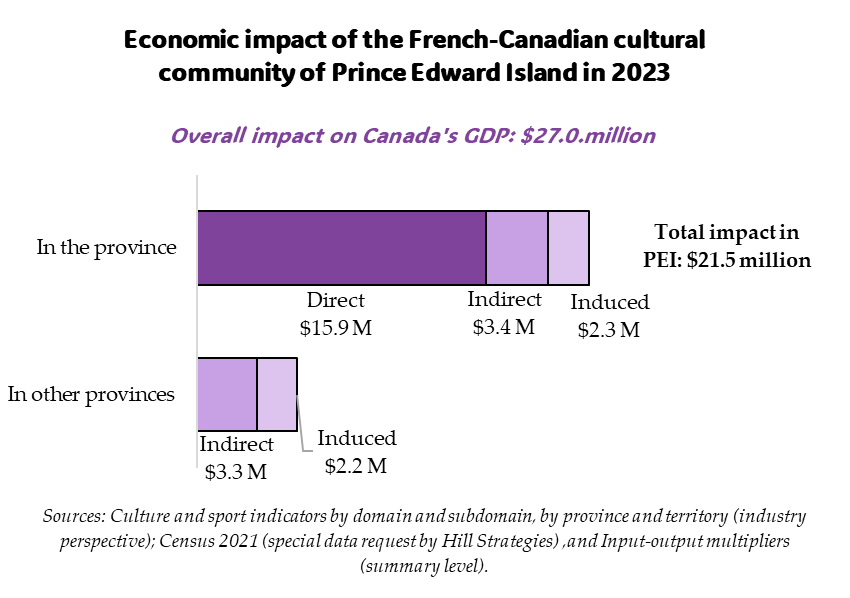
Total revenues from Francophone cultural production on the Island amounted to $25.1 million in 2023.
According to the 2021 census, 190 Francophones in PEI work in culture, representing 7.3% of all cultural workers in the province.
Nova Scotia
The impact on Nova Scotia’s GDP of Francophone arts, culture, and heritage in the province was $171 million in 2023. In other Canadian provinces, the impact was nearly $38 million. The Canada-wide impact was $209 million in 2023, an increase of 20% from 2021 ($174 million).
The estimated impact in N.S. includes:
A direct impact of $113 million.
An indirect impact of $35.9 million.
An induced impact of $22.7 million.
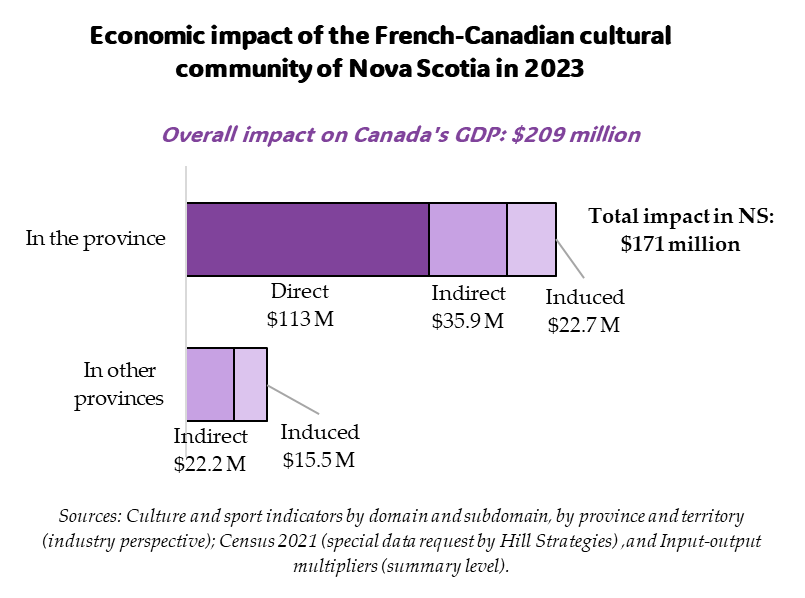
Revenues from Francophone cultural production in Nova Scotia totalled $197 million in 2023.
In Nova Scotia, 1,100 cultural workers speak French, representing 5.6% of all cultural workers in the province.
New Brunswick
The impact of Francophone arts, culture, and heritage on New Brunswick’s GDP amounted to $603 million in 2023. In addition, the impact in other provinces was $166 million, for a Canada-wide impact of $769 million, an increase of 5% since 2021 ($733 million).
The estimated impact in New Brunswick in 2023 includes:
A direct impact of $420 million.
An indirect impact of $115 million.
An induced impact of $67.6 million.
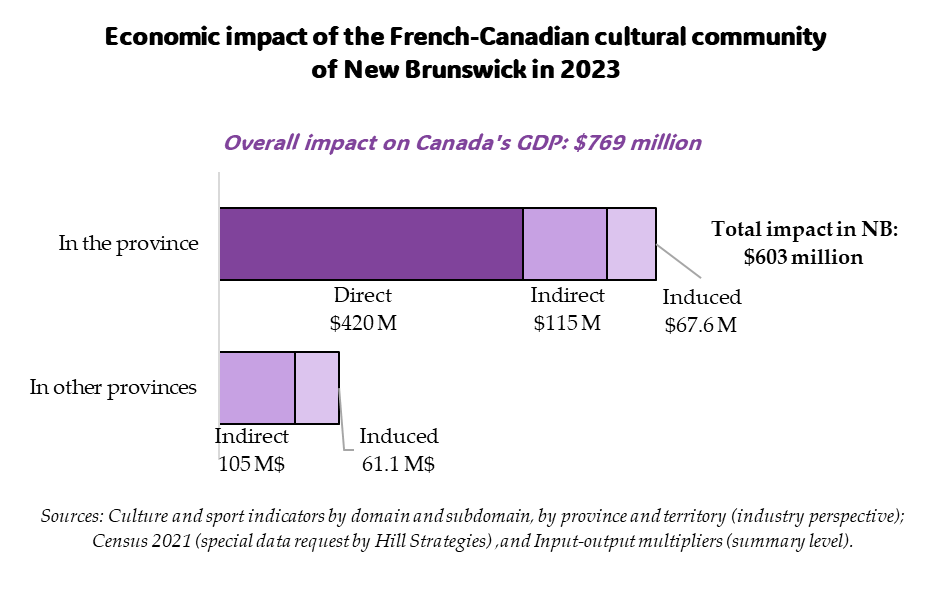
Total revenues from Francophone cultural production in New Brunswick amounted to $686 million in 2023.
In New Brunswick, 3,900 Francophones work in culture, representing 34% of all cultural workers in the province, according to an analysis of the 2021 census by Hill Strategies.
Ontario
The impact of Franco-Ontarian arts, culture, and heritage on Ontario’s GDP was $3.3 billion in 2023. Added to this figure is an impact of $0.3 billion in other Canadian provinces, for a Canada-wide impact of $3.6 billion, an increase of 7% since 2021 ($3.3 billion).
The estimated impact in Ontario in 2023 includes:
A direct impact of $1.8 billion.
An indirect impact of $0.9 billion.
An induced impact of $0.6 billion.
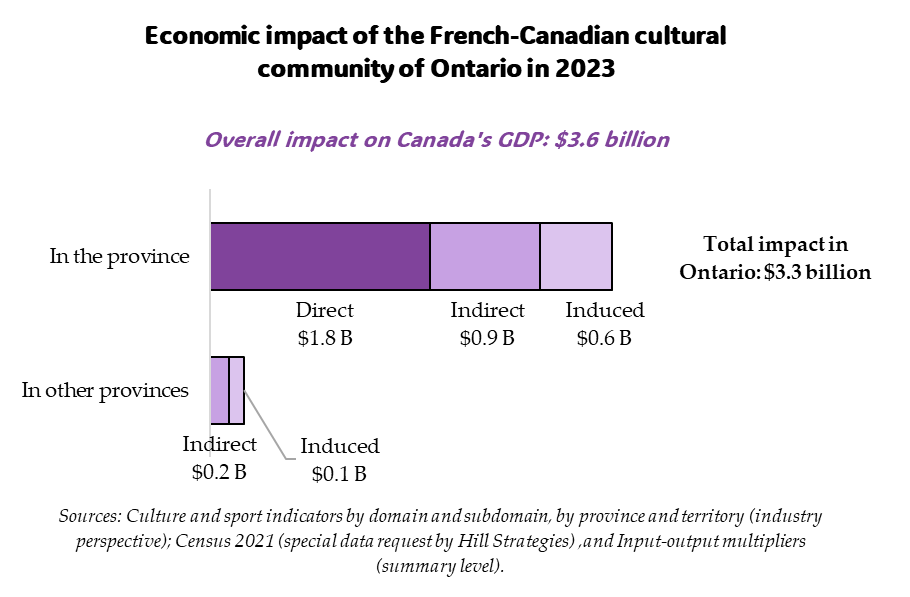
Total revenues from Franco-Ontarian cultural production stood at $3.5 billion in 2023.
According to an analysis of the 2021 census by Hill Strategies, 20,800 Francophones work in culture in Ontario, representing 5.6% of all cultural workers in the province.
Manitoba
The impact of Francophone arts, culture, and heritage on Manitoba’s GDP was $168 million in 2023. In addition, the impact was $38 million in other Canadian provinces, for a total impact of $205 million. This is a slight increase (2%) from the 2021 estimate ($202 million).
The estimated impact in Manitoba includes:
A direct impact of $111 million.
An indirect impact of $29.9 million.
An induced impact of $27.1 million.
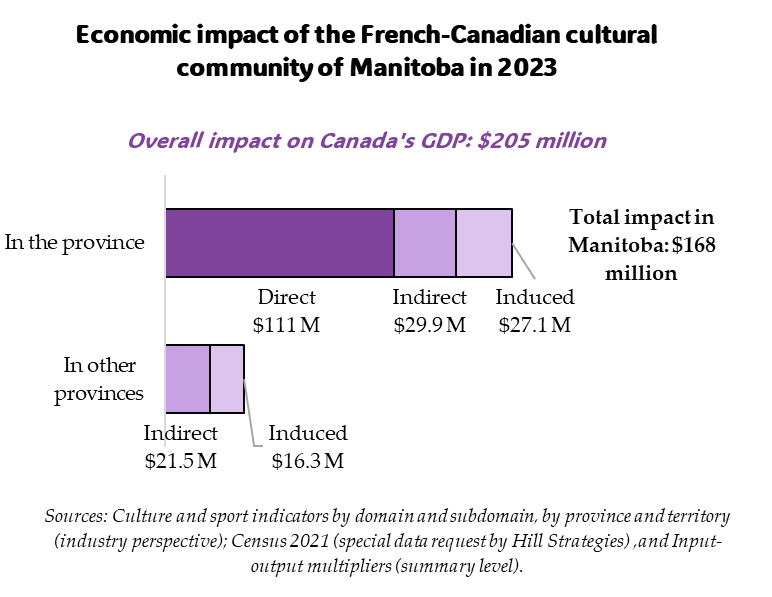
Total revenues from Francophone cultural production in Manitoba amounted to $205 million in 2023 (which coincidentally corresponds to the net impact on Canada’s GDP).
In Manitoba, 1,400 cultural workers speak French, representing 5.8% of all cultural workers in the province.
Saskatchewan
The impact of the Fransaskois cultural community on Saskatchewan’s GDP amounted to $83.6 million in 2023. Added to this figure is an impact of nearly $19 million in other Canadian provinces, for a Canada-wide impact of $102 million, an increase of 9% since 2021 ($93.5 million).
The estimated impact in Saskatchewan includes:
A direct impact of $57.2 million.
An indirect impact of $15.5 million.
An induced impact of $10.9 million.
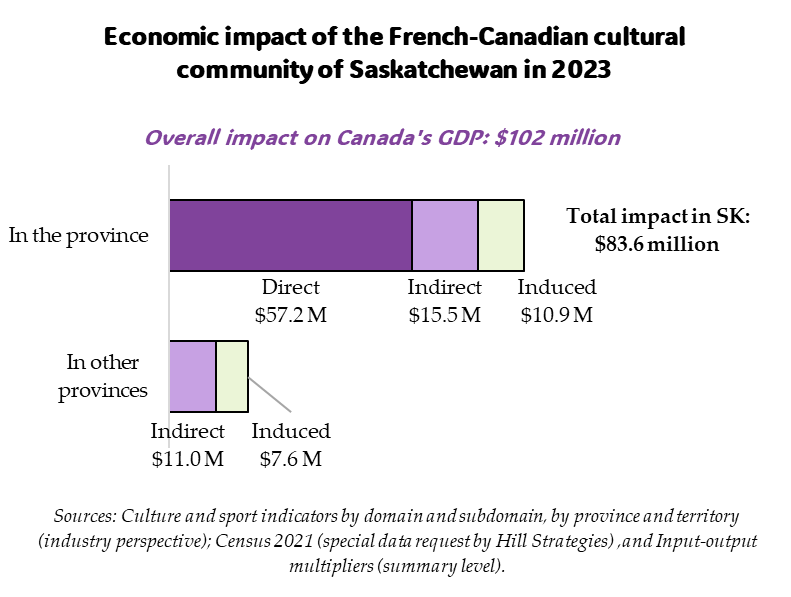
Revenues from Fransaskois cultural production totalled $96 million in 2023.
In Saskatchewan, 520 Francophones work in culture, representing 3.2% of all cultural workers in the province.
Alberta
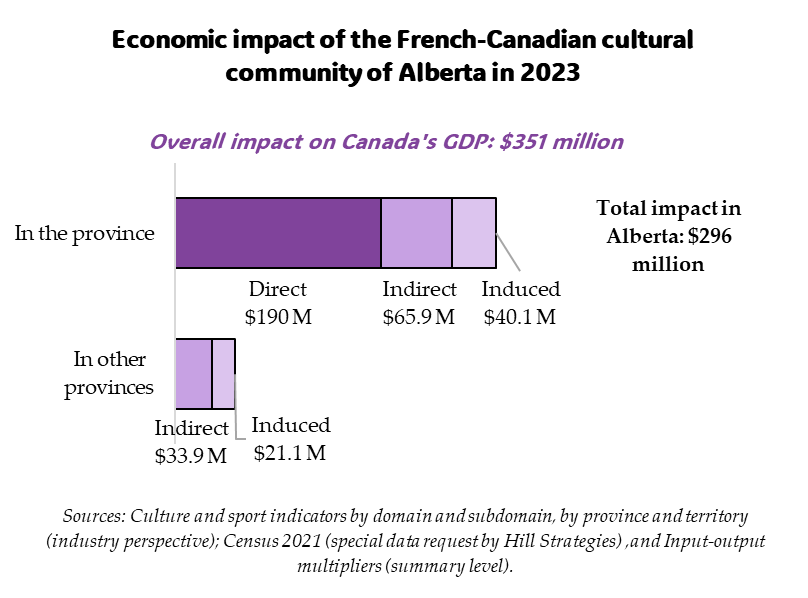
The impact of Francophone arts, culture, and heritage on Alberta’s GDP was $296 million in 2023. Added to this figure is an impact of $55 million in other Canadian provinces, for a Canada-wide impact of $351 million, which is 8% higher than the 2021 estimate ($324 million).
The estimated impact in Alberta includes:
A direct impact of $190 million.
An indirect impact of $65.9 million.
An induced impact of $40.1 million.
Total revenues from Francophone cultural production in Alberta amounted to $337 million in 2023.
In the province, 2,600 cultural workers speak French, representing 3.2% of all cultural workers in the province.
British Columbia
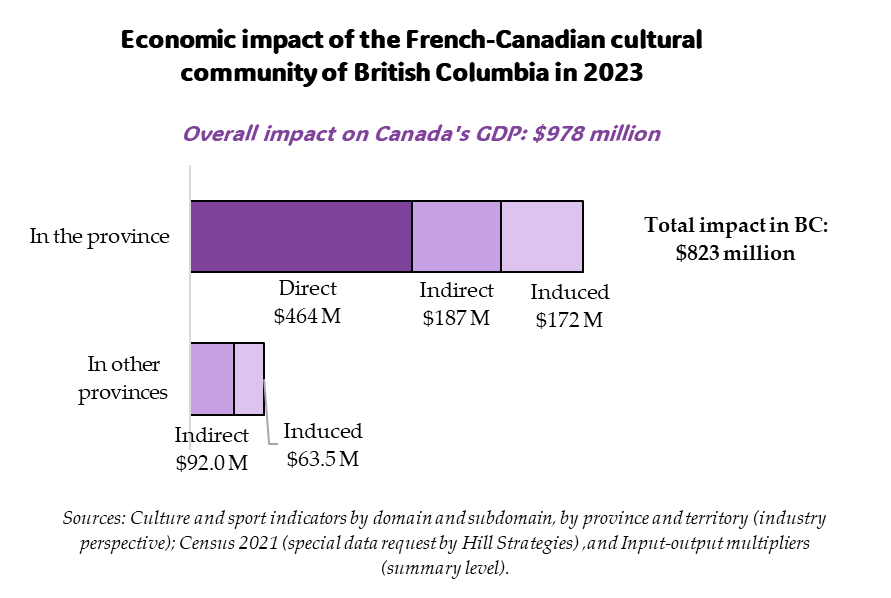
The impact of Francophone arts, culture, and heritage on British Columbia’s GDP was $823 million in 2023. In addition, the impact was $156 million in other Canadian provinces, for a Canada-wide impact of $978 million, an increase of 15% over the 2021 estimate ($851 million).
The estimated impact in B.C. includes:
A direct impact of $464 million.
An indirect impact of $187 million.
An induced impact of $172 million.
Total revenues from Francophone cultural production in British Columbia amounted to $852 million in 2023.
In the province, 5,300 Francophones work in culture, representing 3.4% of all cultural workers, according to an analysis of the 2021 census by Hill Strategies.
Yukon, Northwest Territories and Nunavut
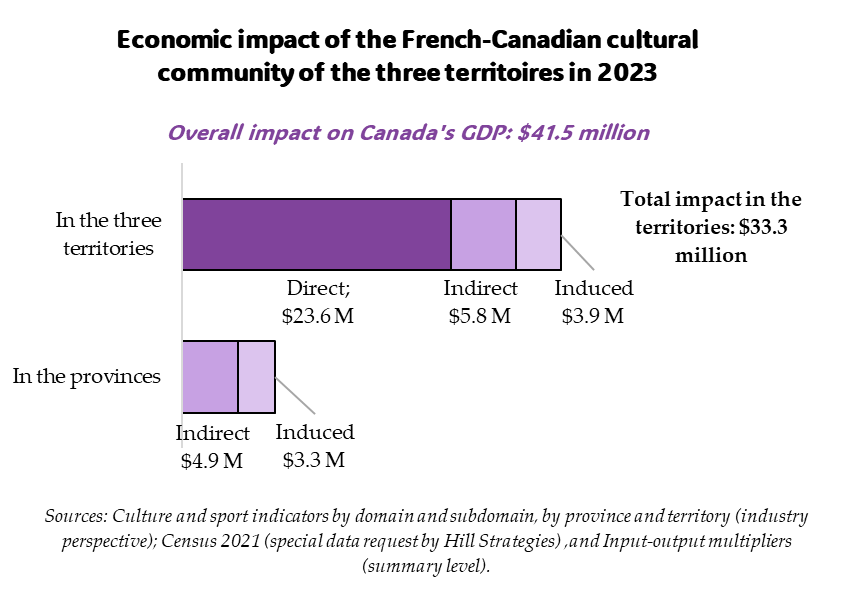
The impact of Francophone arts, culture, and heritage on the GDP of the three territories was $33.3 million in 2023. Added to this figure is an impact of $8.2 million in the provinces, for a Canada-wide impact of $41.5 million, an increase of 9% compared to 2021 ($37.9 million).
The estimated impact in the territories includes:
A direct impact of $23.6 million.
An indirect impact of $5.8 million.
An induced impact of $3.9 million.
Total revenues from Francophone cultural production in the territories amounted to $42 million in 2023 (which coincidentally equals the net impact on GDP).
In the three territories, 230 Francophones work in culture, representing 8.7% of all cultural workers.
Notes on methods
Statistics Canada defines culture as “creative artistic activity and the goods and services produced by it, and the preservation of heritage”. The calculations relating to economic impact follow this definition of culture, as put forward in the Conceptual Framework for Culture Statistics, 2011. However, translation was the only writing profession left out of the Conceptual Framework for Culture Statistics. We have chosen to include translators among the 52 cultural professions.
The calculations of the proportions of Francophones in cultural professions in Canada and each province are based on a linguistic definition produced by Statistics Canada in the 2021 census: the “potential demand for federal communications and services in the minority official language”. This fairly broad definition includes people outside Quebec whose mother tongue is French and/or who speak French at home, whether it is their primary or secondary language. In total, there are 1.4 million people outside Quebec who would potentially request federal services in French.
Here is a summary of other important choices made in developing the economic impact estimates.
For all estimates:
Statistics on the direct impact of culture (in total, i.e., all languages combined) are drawn from Statistics Canada’s cultural indicators by province and territory (industry perspective). Statistics Canada does not offer these indicators by linguistic group.
The industry perspective was chosen for two reasons: 1) these estimates represent culture as an industry, rather than cultural products that may be produced in disparate sectors of the economy; and 2) Statistics Canada’s multipliers are based on an industry perspective.
The proportion of the economic impact allocated to Francophones comes from the proportion of Francophones outside Quebec in 52 cultural occupations. According to Hill Strategies’ special data request from the 2021 census, there are 36,100 Francophone cultural workers outside Quebec, representing 5.2% of the 688,500 cultural workers outside Quebec.
The 52 occupational groups retained as cultural workers include workers in the performing arts, sound recording, film, video, broadcasting, libraries, archives, galleries, museums and other heritage institutions, architecture, design, publishing and printing.
The number of Francophones is based on the potential demand for federal communications and services in the minority official language. These individuals have French as their mother tongue and/or speak French at home, whether as their primary or secondary language.
For direct impact:
The most recent estimates of the direct impact of culture are from 2023.
The direct impact of the cultural sector on gross domestic product (GDP) outside Quebec, regardless of language, amounted to $55.4 billion in 2023.
Given that Francophones represent 5.2% of cultural workers outside Quebec, the direct impact of Francophone cultural activity is estimated at 5.2% of $55.4 billion, or $2.9 billion.
For indirect, induced and total impacts:
We calculated the indirect and induced impacts using Statistics Canada’s national and provincial input-output multipliers for 2021 (the most recent year). These multipliers are regularly used in this type of analysis. For example, the Culture, Arts, Heritage and Sport Economic Impact Model, put forward by Statistics Canada and Canadian Heritage, is based on these multipliers.
This report uses the most recent economic statistics and multipliers. Ideally, the economic statistics and multipliers would refer to the same year, but this is not the case. Nevertheless, in our opinion, the best approach in this situation is to use the most recent data available.
Calculations for Canada excluding Quebec are based on input-output multipliers for Canada as a whole, not an average of the multipliers for the provinces and territories excluding Quebec.
Statistics Canada’s multipliers cover fairly broad sub-sectors. We have chosen the two most “cultural” sub-sectors: information and cultural industries (which includes publishing, film and sound recording, and broadcasting) and arts, entertainment, and recreation (which includes the performing arts and heritage). Unfortunately, these two sub-sectors extend beyond the cultural sector to include telecommunications, data processing and hosting, sports, lotteries, and entertainment. This is an imperfect choice, but the best possible choice in our opinion.
To produce a single multiplier for Canada and for each province, we calculated the average of the multipliers for these two subsectors. We applied this average to the total revenues from cultural activity (referred to as “production” by Statistics Canada) to calculate the indirect and induced impacts.
Statistics Canada provides estimates of the direct economic impact of culture expressed in basic prices. We therefore opted for multipliers expressed in the same way, rather than in market prices.
The value of cultural production outside Quebec, not divided by language, was $104 billion in 2023.
The value of Francophone cultural production outside Quebec in 2023 was estimated at $5.44 billion, or 5.2% of $104 billion.
Most economic impact analyses take into account indirect and induced impacts. In our opinion, these impacts are valid, but there is not universal agreement about this. For example, the Culture, Arts, Heritage and Sport Economic Impact Model, put forward by Statistics Canada and Canadian Heritage, includes indirect and induced impacts. However, Statistics Canada’s culture indicators only provide estimates of direct impact.
The estimates do not take into account ancillary expenditures by cultural attendees, such as accommodation, food, and transportation. The measurement of ancillary expenditures poses challenges and is subject to disagreement, and these expenditures are often excluded from other economic impact studies.