
Culture in British Columbia has an economic impact of more than $24 billion in the province
Plus: Rough estimate of the impact in the Columbia Basin

This article provides an estimate of the economic impact of British Columbia-based arts, culture, and heritage in 2023, the most recent year with available data.
The article presents an industry-based estimate of economic impact, with the term “cultural industries” referring to all organizations, businesses, and individuals working in culture, not just for-profit businesses (as this term is sometimes used). Specifically, the GDP estimates in this article represent the economic value added by cultural organizations, businesses, and individuals. They include the value added of both cultural and non-cultural goods and services produced by cultural establishments. On the other hand, the estimates exclude the value added of cultural goods and services that are produced in industries that are not primarily cultural.
Statistics Canada’s standard definition of culture has been followed, a definition that includes nine domains: live performance; visual and applied arts; written and published works; sound recording; audiovisual and interactive media; heritage and libraries; governance, funding, and professional support; education and training; and multi-domain.
The article was prepared at the request of the West Kootenay Regional Arts Council. Hill Strategies retained analytical independence and editorial control of the content.

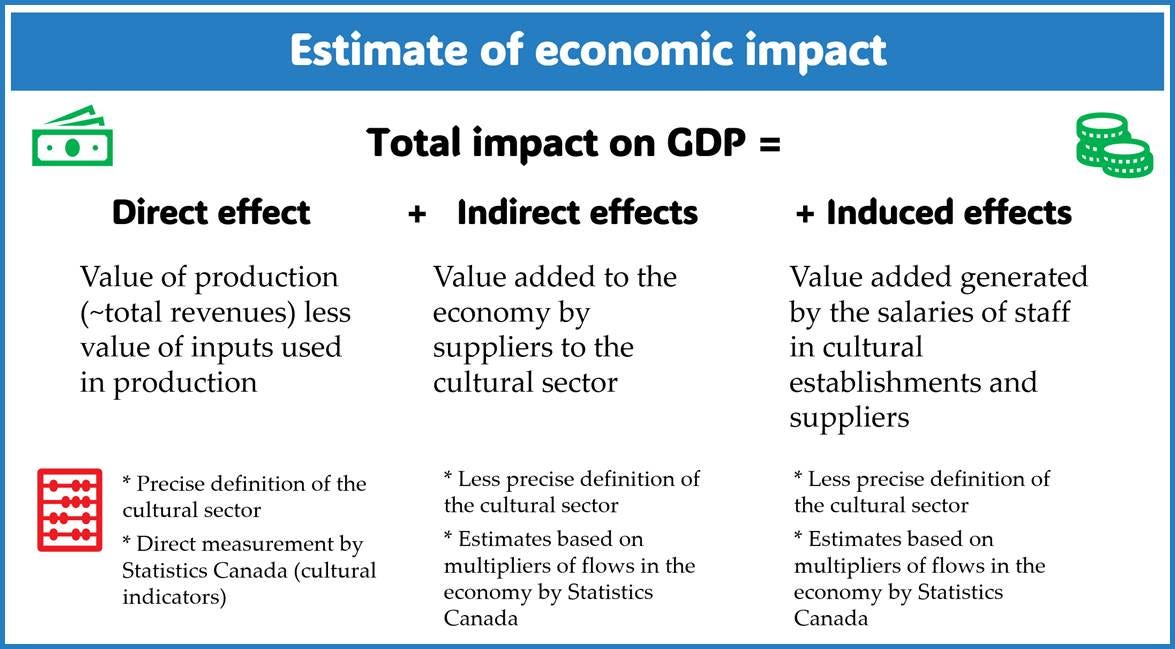
The article includes estimates of the direct, indirect, and induced impacts of cultural activity:
Direct impacts are defined as the value added to gross domestic product (GDP) of spending in the cultural sector.
Indirect impacts represent the new spending that is generated by the expenses of cultural organizations (e.g., by suppliers).
Induced impacts capture the spending that is generated by the earnings of cultural workers and suppliers’ workers.
The following graphic highlights the economic impact components.
The estimates in this report do not take into account ancillary spending by cultural attendees on items such as accommodation, food, and transportation. This is an important decision: estimates of ancillary spending are typically quite large, sometimes equal to estimates based solely on direct, indirect, and induced impacts. However, ancillary spending is difficult to measure, not universally agreed upon, and therefore often excluded from economic impact studies.
The analysis relies on two Statistics Canada products: provincial cultural indicators and input-output multipliers. In general, the analysis is detailed and defensible, but it is also pragmatic. It is based on readily available data, rather than custom surveys of the cultural sector, which would be a very large undertaking.
The estimates in this report are based on data from 2023, the most recent year for the provincial cultural indicators from Statistics Canada. As noted above, the estimates are generated from industry-based indicators for the cultural sector. Hill Strategies believes that the industry-based estimates are the best choice, for three reasons: 1) they represent the industry of culture, rather than cultural products that may be produced in disparate sectors of the economy; 2) Statistics Canada’s multipliers are based on industry definitions; and 3) comparisons with other sectors use industry-based definitions of those sectors.
The other option would be to produce estimates based on cultural products (not cultural industries). A recent report from the Canadian Chamber of Commerce chose this option, which resulted in a lower estimate of the economic impact of British Columbia’s arts, culture, and heritage (but the estimate was still substantial, at nearly $24 billion across Canada, not just in B.C.).
Readers are cautioned that GDP measures only the financial effects of culture. Many other benefits are not taken into account. These benefits are incredibly important for the quality of life (e.g., health, education, the environment, joy, happiness).
Additional notes regarding the methods and products that are used in the calculations can be found after the data analysis.
Culture: Over $24 billion in economic impact in B.C.
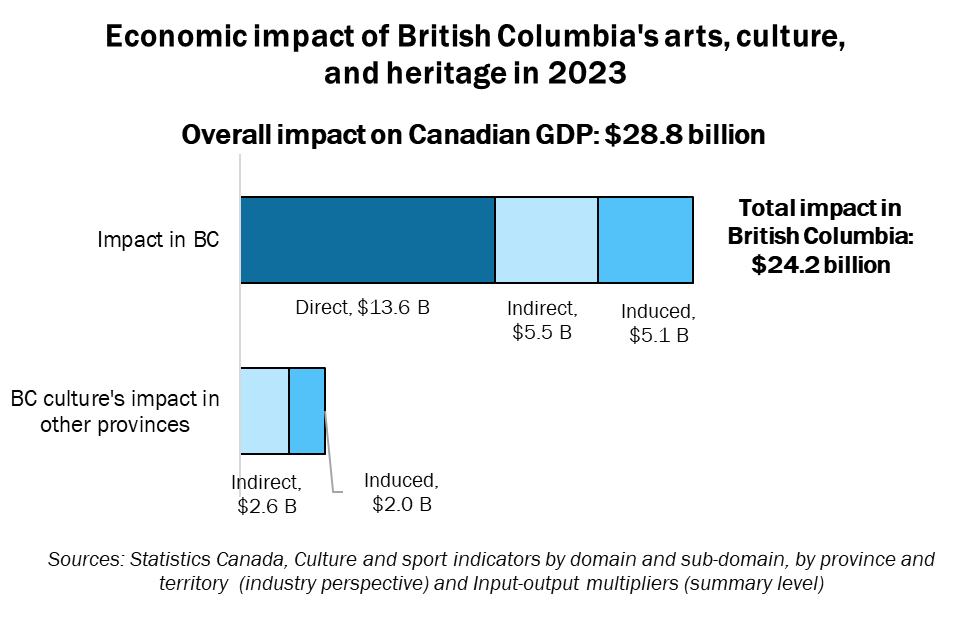
The economic impact of the arts, culture, and heritage on British Columbia’s GDP is estimated at $24.2 billion in 2023. The impact on the GDP of other provinces amounts to $4.6 billion, resulting in an overall impact of $28.8 billion across the country.
The estimate of the impact in B.C. includes:
A direct impact of $13.6 billion.
An indirect impact of $5.5 billion.
An induced impact of $5.1 billion.
A broader economic statistic – the value of B.C.-based arts, culture, and heritage production, which is essentially equal to total revenues in the sector – amounts to $25.1 billion. This “gross” estimate was used as the starting point for the calculations of “net” impacts on GDP (direct, indirect, and induced).
Direct jobs in B.C
Statistics Canada estimates that British Columbia’s arts, culture, and heritage sector directly employed 132,400 people in 2023. This estimate does not include a division into full-time and part-time positions. Estimates of indirect and induced jobs have not been produced for this report.
Comparisons with other sectors of the economy
The estimate of the direct economic impact of the arts, culture, and heritage on British Columbia’s GDP ($13.6 billion) represents 3.6% of provincial GDP ($373 billion).
The direct impact of culture on British Columbia’s GDP is designed to be comparable to other sectors of the economy. Elements such as indirect, induced, and ancillary impacts are typically not comparable to other sectors, because the methods used to estimate these impacts may differ from one study to another, and not all sectors have such a study. For information, the overall estimate of the impact of culture ($24.2 billion, including direct, indirect, and induced impacts) represents 6.2% of the province’s economy. However, if the indirect and induced impacts of every sector were summed, the total would be much larger than overall provincial GDP.
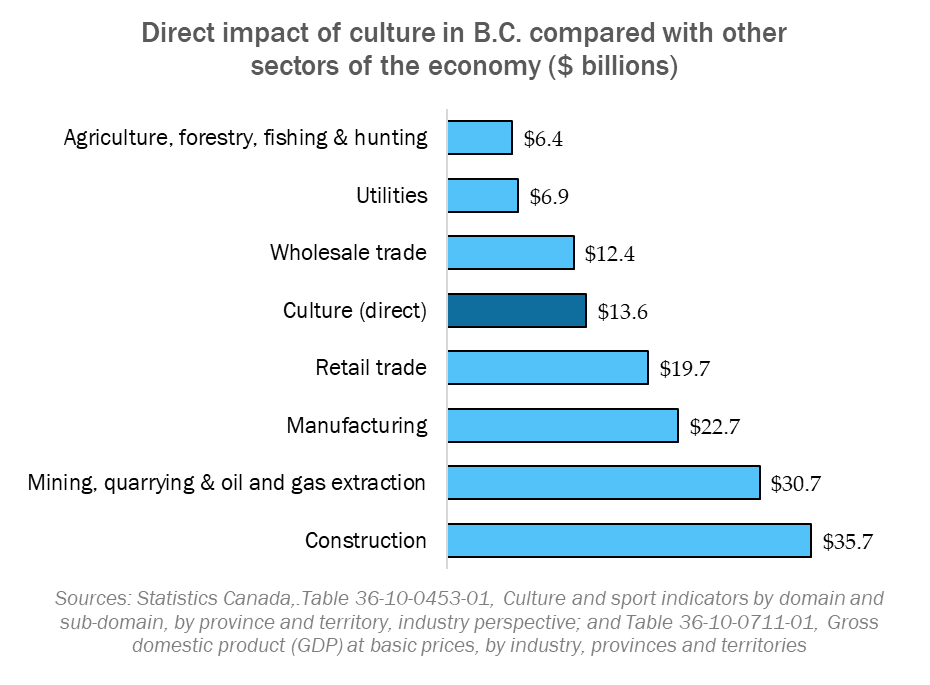
As shown in the graph below, culture’s $13.6 billion in direct economic impact in B.C. is larger than the direct impact on GDP of other important sectors of the province’s economy. Culture is:
More than twice as large as the impact of agriculture, forestry, fishing, and hunting ($6.4 billion)
Roughly twice as large as the impact of utilities ($6.9 billion)
9% larger than wholesale trade ($12.4 billion)
On the other hand, the direct impact of the arts, culture, and heritage is less than (but still represents a significant share of) some of the largest sectors of the province’s economy. Culture represents:
69% of the GDP of retail trade ($19.7 billion)
60% of the GDP of manufacturing ($22.7 billion)
44% of the GDP of mining, quarrying, and oil and gas extraction ($30.7 billion)
38% of the GDP of construction ($35.7 billion)
The data source for the comparison sectors and the overall provincial economy is Statistics Canada’s estimates of GDP at basic prices, by industry, using current dollar estimates. The notes contain further information about the comparisons.
A comparison with government spending on culture in the province is not provided here, because it would not be an apples-to-apples comparison. Statistics Canada has not allocated federal spending by province, which means that the government spending estimate in the province is only a portion of total spending.
Economic impact estimates for the Columbia Basin
The following local economic impact statistics should be considered rough estimates, as they were prepared using readily available statistics on cultural workers in local regions. The economic data needed for a fuller exploration are not readily available at the local level.
The Columbia Basin is an area of southeastern B.C., whose borders are not perfectly aligned with municipal geographies. To best align with regional boundaries, this analysis of the Columbia Basin reflects the same boundaries as a prior analysis. Specifically, it excludes Basin communities located in Regional District of Kootenay Boundary. Still, a large portion of the Basin is examined in this article, despite limitations due to the need to define the Basin based on municipal borders (to be consistent with Statistics Canada datasets). In this article, the Columbia Basin comprises all of the Regional District of Central Kootenay, all of the Regional District of East Kootenay, and a portion of the Columbia Shuswap Regional District. Separate estimates are provided here for the two regional districts that are fully contained within the Columbia Basin.
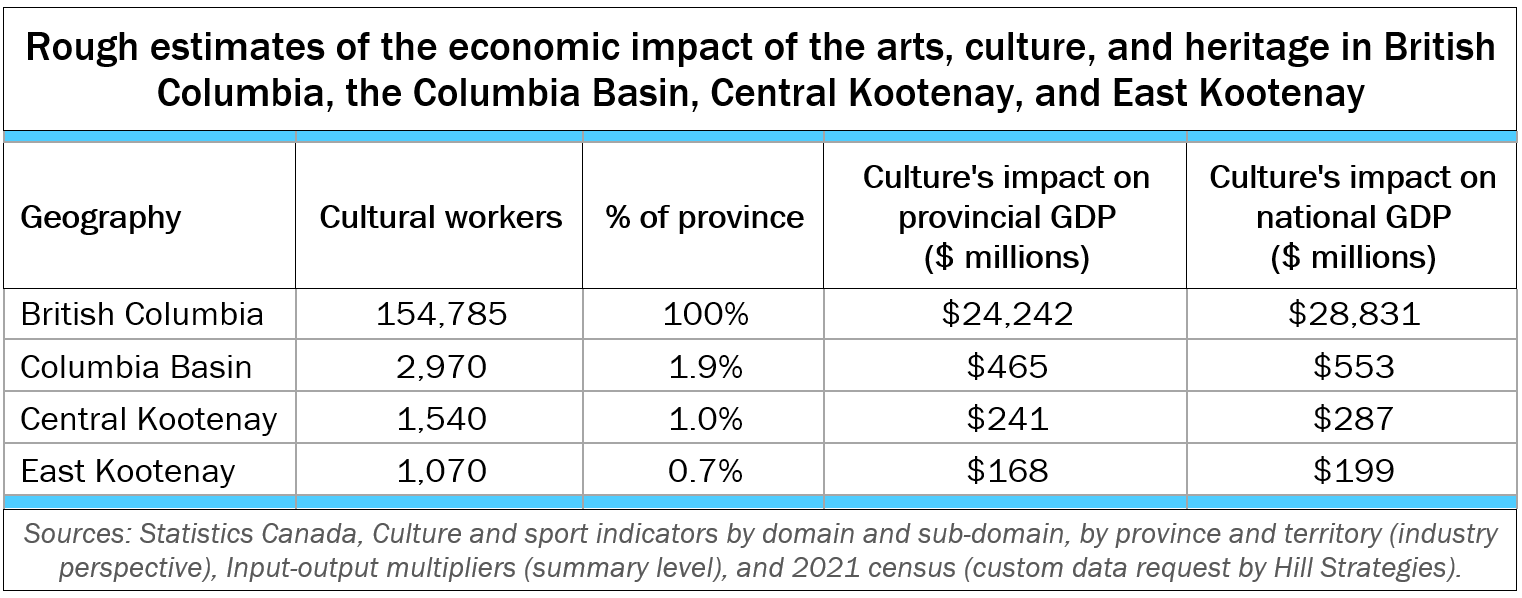
The following table outlines the census count of the number of cultural workers in 2021 (which forms the basis for the economic estimates), as well as the rough estimates of the local economic impacts of the arts, culture, and heritage. Further information on artists and cultural workers in these areas can be found in an article from 2023.
As shown in the following table, the arts, culture, and heritage are estimated to have impacts on the provincial economy of $465 million in the Columbia Basin, including $241 million in Central Kootenay and $168 million in East Kootenay.
Once again, the local estimates should be considered as imperfect. For example, the local estimates do not account for how various segments of the arts, culture, and heritage might be different in the Columbia Basin’s cultural scene from the province as a whole.
Notes on methods
Statistics Canada defines culture as “creative artistic activity and the goods and services produced by it, and the preservation of heritage“. The economic impact calculations in this report follow this definition, which was established in the Conceptual Framework for Culture Statistics, 2011.
The cultural data in this report were drawn from Statistics Canada’s Culture and sport indicators by domain and sub-domain, by province and territory (industry perspective). This product offers statistics on the direct impact and overall production of cultural industries in B.C.
The broadest estimates from Statistics Canada’s Culture and sport indicators relate to the value of cultural production (essentially equal to total revenues). This estimate was $25.1 billion in B.C. in 2023. Statistics Canada’s Culture and sport indicators also provide an estimate of the direct impact of culture on GDP in B.C. ($13.6 billion in 2023).
Estimates of the indirect and induced impacts were produced using Statistics Canada’s provincial input-output multipliers for 2022. Multipliers reflect the interrelatedness of specific industries, based on Statistics Canada’s economic measurements. These multipliers are commonly used in this type of analysis, including in The Culture, Arts, Heritage and Sport Economic Impact Model, developed by Statistics Canada and Canadian Heritage.
This report uses the most recent economic statistics and multipliers at the time of writing. In general, the multipliers are one to two years behind the economic estimates (i.e., the direct impact of culture in the provinces and territories). It is not ideal that the economic statistics relate to 2023, while the multipliers are from 2022. Nevertheless, in our opinion, the best way to proceed in this situation is to use the most recent data available.
Statistics Canada’s multipliers cover fairly broad sub-sectors. We have chosen the two most “cultural” sub-sectors: Information and cultural industries (which includes publishing, film, sound recording, and broadcasting) and Arts, entertainment, and recreation (which includes the performing arts and heritage). Unfortunately, these two sub-sectors extend beyond the cultural sector to include telecommunications, data processing and hosting, spectator sports, lotteries, and entertainment. This is an imperfect choice, but the most feasible option, in our opinion.
To produce a single multiplier for British Columbia, we calculated the average of the multipliers for these two sub-sectors. To calculate the indirect and induced impacts, the multiplier was applied to the total value of cultural production in the province.
Because Statistics Canada offers estimates of the direct economic impact of culture expressed in terms of basic prices, we chose the “matching” multipliers for indirect and induced impacts, i.e., those expressed in terms of basic prices (rather than market prices). Similarly, the GDP estimates for comparison sectors and the overall economy are expressed in terms of basic prices.
Most – but not all – economic impact analyses include indirect and induced impacts. In our opinion, these impacts are valid, but not everyone agrees on this matter. On one side, The Culture, Arts, Heritage and Sport Economic Impact Model, developed by Statistics Canada and Canadian Heritage, includes indirect and induced impacts. However, Statistics Canada’s Culture indicators only provide estimates of the direct impact. Few studies account for ancillary spending by cultural attendees on items such as accommodation, food, and transportation.
As noted above, the data source for the comparison sectors and the overall economy is Statistics Canada’s estimates of GDP at basic prices, by industry, using current dollar estimates to ensure comparability with the cultural statistics. Unfortunately, the most recent current dollar estimates by province relate to 2022. These estimates were adjusted based on the growth rates of chained dollar estimates for the same sectors between 2022 and 2023, available from the same dataset. These calculations result in the most comparable (current dollar) estimates for 2023, the most recent year for the cultural statistics.