
Types of training offered by organizations and businesses in the arts, heritage, and entertainment in Canada
Also: Do organizations include information about people with disabilities in their training?

Two months ago, I showed that relatively few organizations and businesses in the arts, heritage and entertainment incorporate accessibility features into their public communications. Today, another iteration of the same Statistics Canada survey highlights a related issue: disability training in the arts, heritage and entertainment. To get to the frequency of disability training, the survey also asked general questions about the types of training offered to employees of organizations and businesses.
These are the two sections in today’s article: 1) how many organizations and businesses in the arts, heritage and entertainment provide different types of training to their employees; and 2) how many offer disability-related information in each type of training.
As I’ve noted before, “arts, heritage, and entertainment” is a broad and imperfect approximation of the cultural sector. This classification (which the survey refers to as “arts, entertainment, and recreation”) includes performing arts, spectator sports, and related industries; heritage institutions; as well as amusement, gambling, and recreation industries. Given the sample size, separate data for culture-specific organizations and businesses are not available. This leaves us with the compromise of a broad category that also includes entertainment and recreation related businesses such as amusement parks, casinos, bingo halls, golf courses, ski hills, marinas, and fitness centres.
Survey and questions
The article is based on a Statistics Canada survey of not-for-profit and for-profit organizations across the economy. This iteration of the Canadian Survey on Business Conditions was conducted between January 2 and February 6. The data were released on February 27.
Statistics Canada asked respondents six questions about workplace training offerings, using the wording “Over the last 12 months, has this business or organization provided any [job-related training about the issues listed below]?”
job-related training about client interaction or service delivery
job-related training about communication
technical job-related training
job-related training about diversity, equity and inclusion
job-related training on workplace accommodations
other job-related training related to accessibility for persons with disabilities
The survey describes training as including “peer mentoring, job shadowing, workshops, lessons, self-learning, team discussions, and webinars”.
The response options were: Yes / No / Don’t know.
Each of the above questions contained a brief description of the specific type of training. For example, the question about diversity, equity, and inclusion gave the following examples: “e.g., mental health awareness, disability inclusion, cultural awareness, unconscious bias, 2SLGBTQ+ inclusion, respecting confidentiality, inclusive hiring, bias awareness, inclusive conflict resolution”.
Information about persons with disabilities
Whenever respondents answered “yes” to one of these questions, a follow-up was asked, along with definitions of “disability” and “persons with disabilities”:
“Did any of this training include information on persons with disabilities?
A disability refers to any impairment, including a physical, mental, intellectual, cognitive, learning, communication or sensory impairment, or a functional limitation.
Persons with disabilities refers to a person who has any impairment, including a physical, mental, intellectual, cognitive, learning, communication or sensory impairment — or a functional limitation — whether permanent, temporary or episodic in nature, or evident or not, that, in interaction with a barrier, hinders a person’s full and equal participation in society.”
Response options: Yes / No / Don’t know
Note about my analysis of disability-related training
Unfortunately, because of the question structure (two questions about each type of training) and data reporting (no rolled-up data by type of organization), it is not possible to estimate the overall number of organizations and businesses in the arts, heritage, and entertainment that provided disability training via any form of training. Data for the separate questions cannot be added together, because many of the same organizations might have provided different types of training.
What I could calculate is the percentage of organizations and businesses in the arts, heritage, and entertainment providing disability training for each specific form of training. To do this, I multiplied the percentage of organizations offering each type of training by the percentage offering information on how to interact with persons with disabilities (a subset of those organizations offering that type of training).
Technical training is the most common type of training in culture
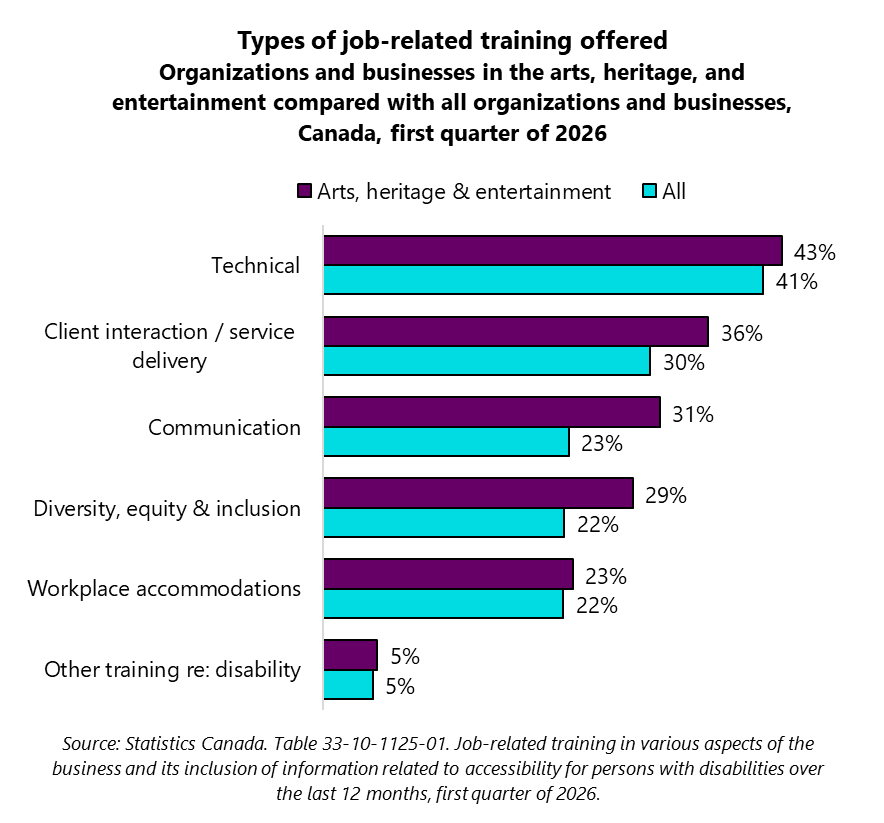
The following graph shows that technical training is the most common type of training among organizations and businesses in the arts, heritage, and entertainment (43% offered such training in the past 12 months). Technical training is also the most common type of training among all businesses and organizations in Canada (41%).
Just over one-third of organizations and businesses in the arts, heritage, and entertainment (36%) offer training on client interaction or service delivery (compared with 30% of all businesses).
31% of organizations and businesses in the arts, heritage, and entertainment offer communication training (compared with 23% of all businesses).
29% of organizations and businesses in the arts, heritage, and entertainment offer training related to diversity, equity, and inclusion (DEI, compared with 22% of all businesses).
23% of organizations and businesses in the arts, heritage, and entertainment offer training related to workplace accommodations (compared with 22% of all businesses).
Finally, 5% of organizations and businesses in the arts, heritage, and entertainment offer other training related to people with disabilities (equal to the percentage of all businesses).
All of the percentages for organizations and businesses in the arts, heritage, and entertainment are equal to or greater than the percentages of all businesses and organizations in Canada.
Data quality indicators: Very good (B rating) for each different type of training among organizations and businesses in the arts, heritage, and entertainment, except “other training”, which had an A rating (excellent). The ratings are excellent (A) for each different type of training among all businesses and organizations in Canada.
Few organizations or businesses in the arts, heritage, and entertainment include training information about people with disabilities
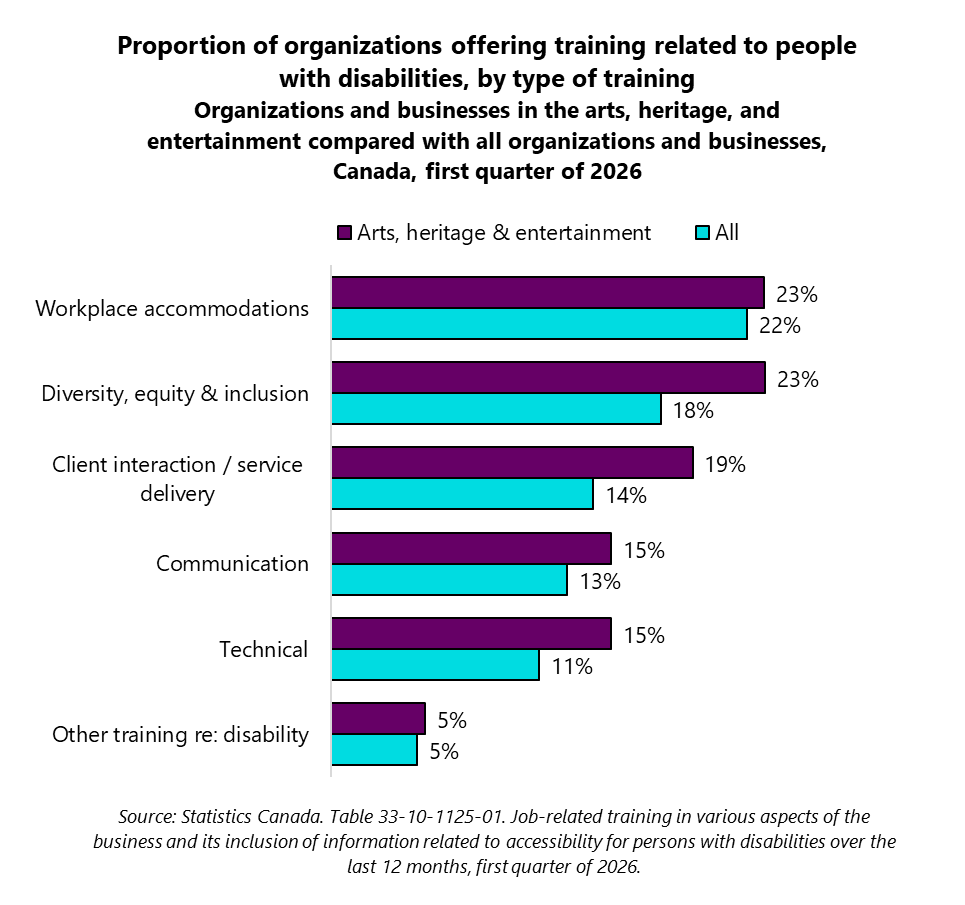
Today’s second graph shows that workplace accommodations and DEI training are the most common types of training related to people with disabilities: an equal proportion (23%) of all organizations and businesses in the arts, heritage, and entertainment offered these types of training in the past 12 months.
These training offerings are followed by disability-related training in client interaction or service delivery (19% of all organizations and businesses in the arts, heritage, and entertainment), communication (15%), technical training (also 15%), and another type of training related to people with disabilities (5%).
All of these percentages are equal to or greater than the percentages of all businesses and organizations in Canada.
Data quality indicators: Acceptable (D rating) for DEI, communication, and client interaction. Good (C rating) for technical training. Very good (B rating) for workplace accommodations.
Which types of training most often incorporate information about people with disabilities?
The above analysis examines the proportion of all organizations and businesses in the arts, heritage, and entertainment (and all businesses and organizations in Canada) offering disability training. In other words, it’s a combination of responses to two questions: Is this training offered? And: does it include information about people with disabilities?
If we simply look at the responses to the second question, we can see which types of training (when offered) are most likely to incorporate information about people with disabilities.
When offered by organizations and businesses in the arts, heritage, and entertainment, DEI training is most likely to include information on how to communicate with persons with disabilities (81%).
Client interaction or service delivery is the second most likely type of training to include information on how to interact with persons with disabilities (54%), followed by communication (48%), and technical training (35%).
All training on workplace accommodations, as well as all “other” training in the survey, relate to people with disabilities.
Data source
Statistics Canada. Table 33-10-1125-01. Job-related training in various aspects of the business and its inclusion of information related to accessibility for persons with disabilities over the last 12 months, first quarter of 2026, https://www150.statcan.gc.ca/t1/tbl1/en/cv!recreate.action?pid=3310112501&selectedNodeIds=2D1,2D15&checkedLevels=0D1,2D1,2D2&refPeriods=20250101,20250101&dimensionLayouts=layout2,layout2,layout3,layout2&vectorDisplay=false
Note regarding provincial data
In theory, provincial data exist on this topic. However, the national data quality is limited (only “acceptable”) for disability training by organizations and businesses in the arts, heritage, and entertainment. As such, provincial data for cultural organizations are unlikely to be reliable. Indeed, a quick scan of the provincial data shows that many fields are hidden and tagged as “too unreliable to be published”, even in the largest province.