

Today’s article examines household spending on the arts, culture, and heritage by population size, as well as some other spending items for context. This is my last article on consumer spending in Canada in 2023. Today’s article is also my last one this calendar year, and I wish you joy and peace this holiday season.
As was the case with my other demographic articles (covering spending by income and age), I’ll compare spending by households residing in areas of different population sizes with benchmark averages from an earlier article on household spending: $531 per household on artworks and arts participation items, representing 0.7% of household spending (after taxes, pension contributions, and gifts are excluded), as well as $1,623 per household on cultural goods and services, representing 2.1% of household spending. For context, I’ll also analyze overall household spending and spending on cars.
The data by population size cover a spectrum of areas in which survey respondents live, including population centres of (a) 1,000,000 residents and over, (b) 500,000 to 999,999, (c) 250,000 to 499,999, (d) 100,000 to 249,999, (e) 30,000 to 99,999, and (f) 1,000 to 29,999. Only areas with a density of 400 or more people per square kilometre are considered “population centres”. Respondents in areas with fewer than 1,000 residents and/or a population density below 400 people per square km are classified as rural.
The article offers two main indicators: dollars spent per household and percentage of household spending. The strength of the percentage estimates is that they place the spending levels in the context of how much money each group of Canadians has to spend.
My category of “artworks and arts participation” includes six items: 1) works of art, carvings, and other decorative ware; 2) books; 3) tickets to live performances; 4) movie tickets; 5) admissions to museums, zoos, and other heritage sites; and 6) art and craft materials. The 19 cultural goods and services include these six items, plus 13 others, all of which are listed at the end of this article. Spending details for individual items that are included in arts spending and cultural spending are not provided in today’s article, due to space and time limitations.
Given the limitations of Statistics Canada’s Survey of Household Spending, I would consider the analysis to be a limited but reasonable approximation of consumer spending on the arts. I would consider the broader estimate of spending on culture (including the arts, culture, and heritage) to be a less-limited approximation, but still imperfect. My categories only include those spending items that are available in the dataset, not everything that one might want to include in arts spending or cultural spending. More details on the survey’s methods and limitations are in the notes at the end of the article.
Context: differences in overall consumption and spending on cars by population size
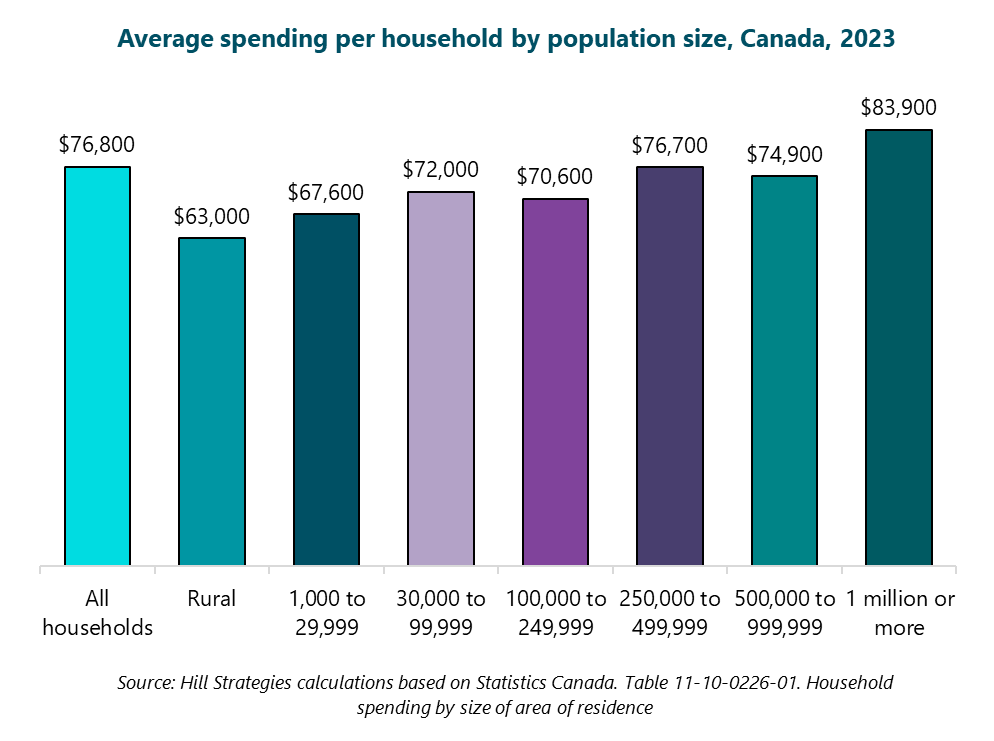
The first graph shows average spending per household on everything. Average consumer spending tends to increase with population size, from an average of $63,000 in rural areas to $83,900 in large cities with at least 1 million residents.
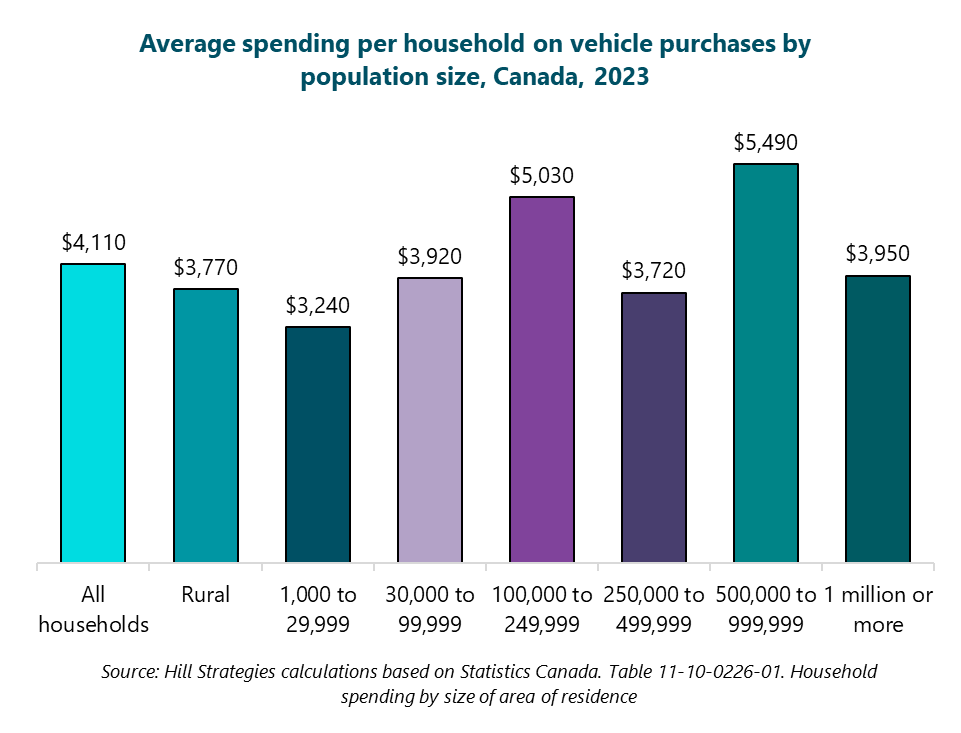
For further context, I’ll examine spending differences on cars. The next graph shows that average spending on vehicles does not have a distinct pattern by population size.
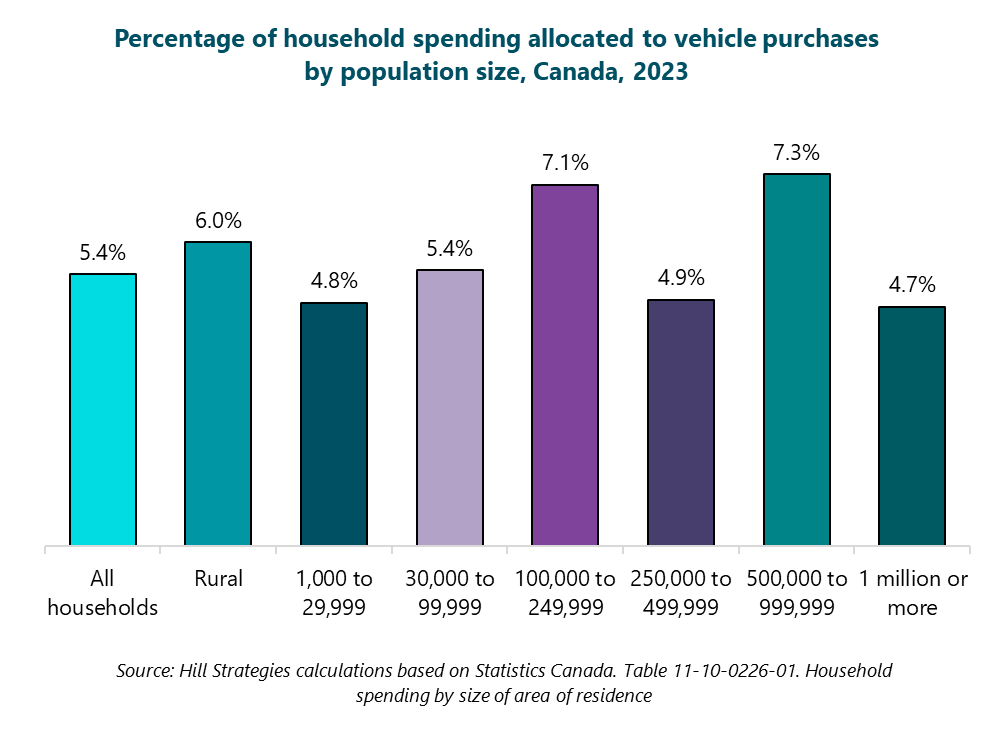
There is no distinct pattern in the final context graph either. As a percentage of total household spending, vehicle purchases are above the national average (5.4%) among rural Canadians (6.0%), residents in cities with 100,000 to 249,999 residents (7.1%), and cities with 500,000 to 999,999 residents (7.3%).
Spending on the arts, culture, and heritage by population size
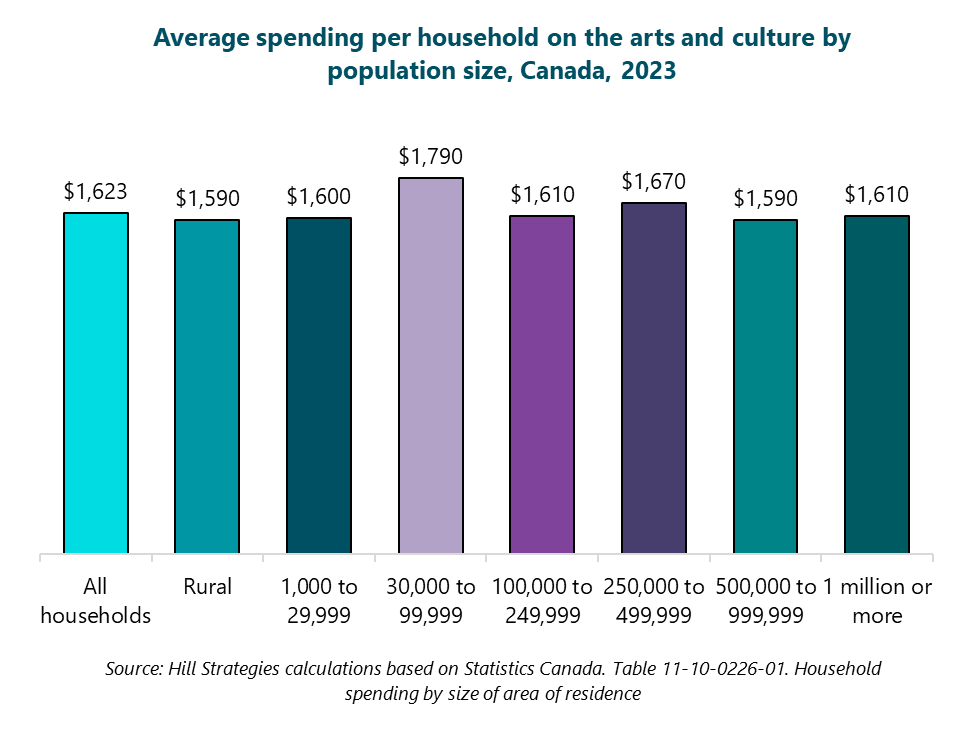
Similar spending on the arts, culture, and heritage in dollar terms
Average cultural spending is very close to the national average ($1,623 per household) in all but one population size group, the exception being residents of areas with populations between 30,000 and 99,999, who spend an above-average amount ($1,790).
Cultural spending as a percentage of household budgets
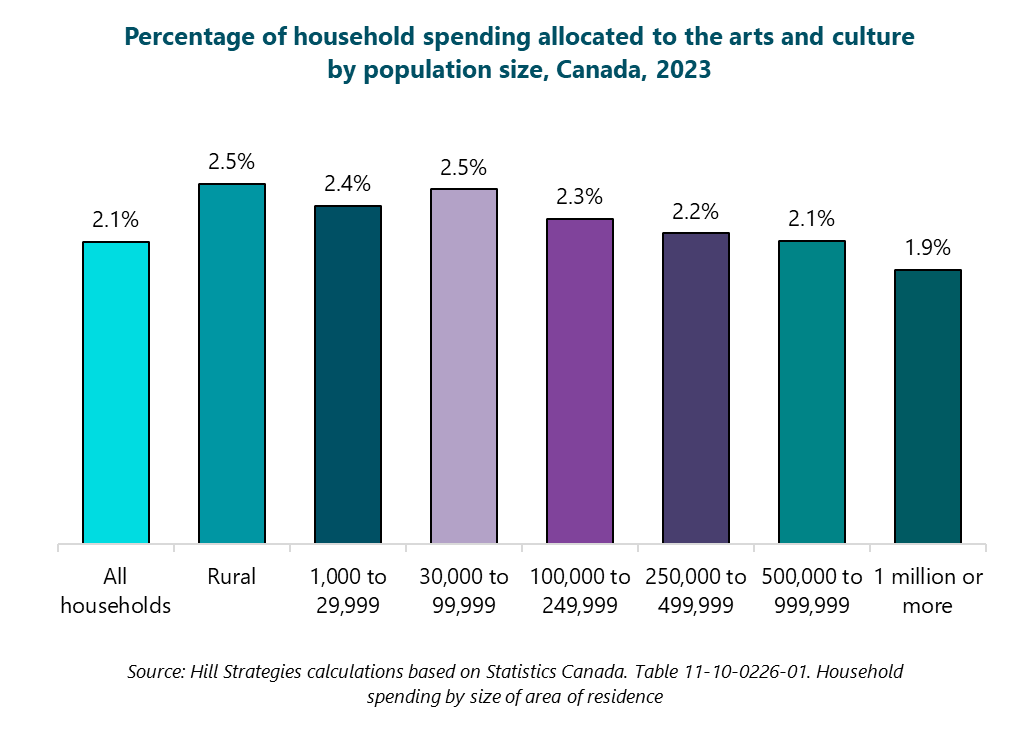
As a percentage of overall household expenses, cultural spending decreases as population size increases. Rural residents spend the highest proportion of their household budgets (2.5%) on the arts, culture, and heritage. Residents of the largest cities (1 million or more) spend the least (1.9%).
Spending on artworks and arts participation in dollar terms
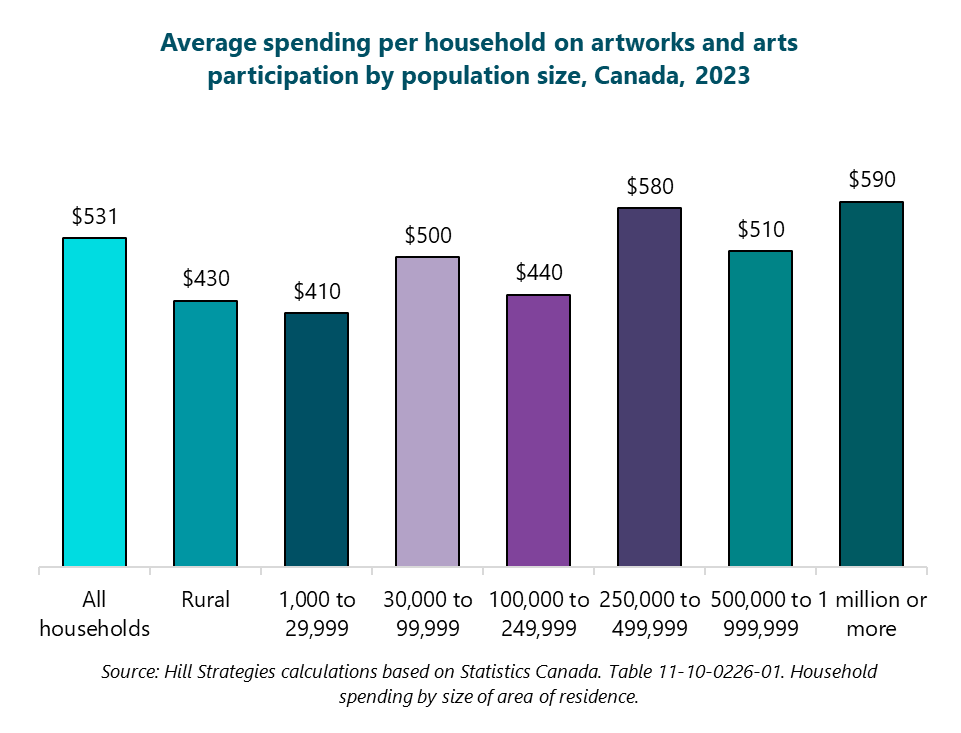
The second last graph shows that average household spending on artworks and arts participation tends to be higher in larger cities.
Spending on artworks and arts participation as a percentage of household budgets
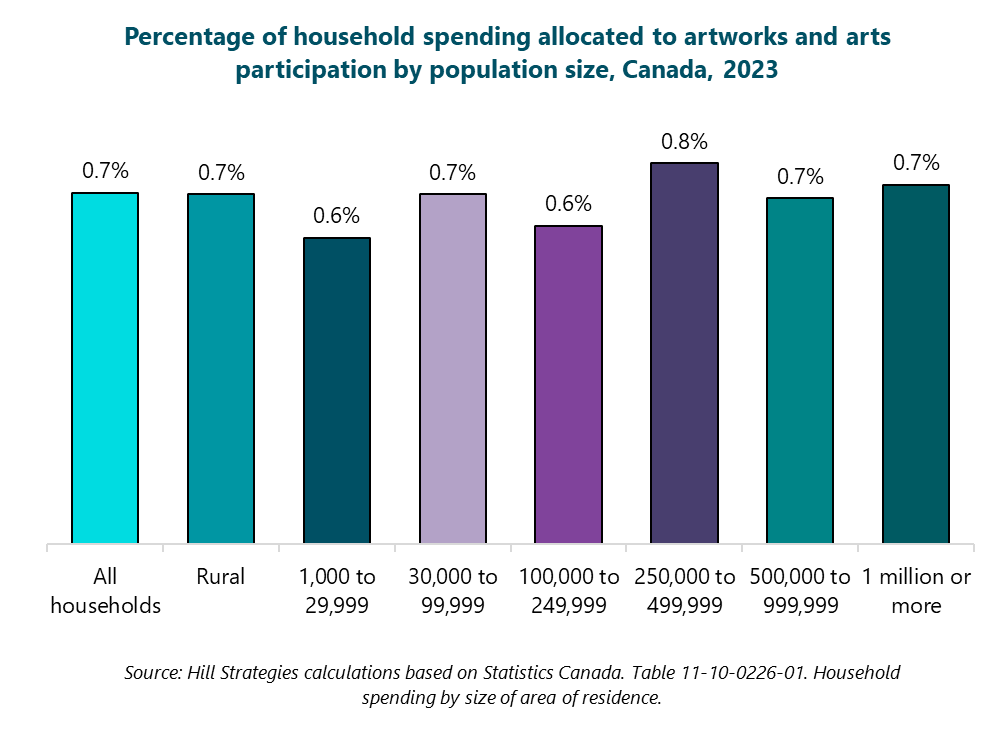
As a percentage of overall household spending, residents in all areas spend similar amounts on artworks and arts participation (0.6% to 0.8%), as shown in the final graph.
Notes about the survey
Data source
Statistics Canada. Table 11-10-0226-01, Household spending by size of area of residence, https://www150.statcan.gc.ca/t1/tbl1/en/tv.action?pid=1110022601.
What is included in cultural spending?
After a close examination of hundreds of line items available in the Survey of Household Spending dataset, I retained 19 items as “cultural spending” and grouped them into the five categories, which are listed in descending order of spending in Canada in 2023. (The individual items within each group are also listed in descending order of spending in Canada.)
1) Home entertainment
TV services and satellite radio services (including installation, service, and pay TV charges, but excluding streaming services)
Televisions
Audio equipment and home theatre systems
Video game systems and accessories (excluding for computers)
Pre-recorded media, music downloads, and blank audio and video media
DVD players, Blu-Ray players, and other video equipment and accessories
2) Cultural events
Live performing arts
Movie theatres
Admission fees to museums, zoos, and other sites
3) Reading material
Books and e-books (excluding school books)
Services related to reading materials (e.g., photocopying, library fees)
Magazines and periodicals
Maps, sheet music, and other printed matter
Newspapers
E-book readers
4) Visual arts and art supplies
Works of art, carvings and other decorative ware
Art and craft materials
5) Photographic services and equipment:
Photographic services
Camcorders, cameras, parts, accessories, and related equipment
Partial and missing data
For some line items, the data were either partially or entirely missing for some population sizes. To counter this lack of reliable data, I produced initial estimates of cultural spending and arts spending based on line items with complete data. I then estimated overall cultural spending and overall arts spending based on the percentage differences of each group (using spending items with complete data) with the average spending for all Canadians. Spending details were missing for 9% of arts spending and 17% of cultural spending.
Survey methods
The Survey of Household Spending (SHS) is a bi-annual questionnaire on the spending habits of individual Canadians. Regarding this survey, Statistics Canada notes that:
“The sample for the 2023 SHS consists of 36,320 households across the 10 provinces”.
Since 2010, “the SHS data have been collected using both a questionnaire and an expenditure diary. The questionnaire is generally used to collect expenditures for more expensive and less frequently purchased goods and services. The diary is used to collect expenditures for smaller, less valuable items and those purchased more frequently. These expenditures may be more difficult to recall.”
The questionnaire portion was self-completed via electronic means, while the “diary was sent to respondents by mail”.
The dataset for 2023 was released in May of 2025.
Survey exclusions and limitations
Because it is a broad survey of overall spending habits, the Survey of Household Spending does not provide information about some types of cultural spending. For example:
Musical instruments, parts, and accessories
Arts courses
Tuition fees for arts-related post-secondary programs
Textbooks (which the survey includes with other school supplies)
In addition, only a rough estimate of spending on live performing arts can be gleaned from the dataset. Live performing arts are grouped in a line item that includes live sports. I estimated each of these two components to provide a rough estimate of spending on live performances. (Here’s how: I used a 52% portion for the performing arts, based on the most recent revenue estimates from another dataset, Supply and Use Tables. However, these revenue estimates have fluctuated over time, and a 52% portion may be a fairly conservative estimate for live performances.)
The dataset examines cultural spending, not all types of participation in cultural activities. Free cultural activities, by definition, are excluded from the data source.