
What's a key economic sector?
Comparison of the GDP of culture and so-called "key" industries

About a year ago, I posted a comparison of the direct impact of the arts, culture, and heritage on Gross Domestic Product (GDP) with select other industries.
Time for a refresh, right?
I’ve been intrigued by federal investments in labour force development in “key economic sectors”. So intrigued that I asked myself, “How does culture fit in?” (Culture could use some “workforce development”, no?)
Today’s article offers the fruits of this rumination, mostly via one key graph. I hope that you’ll find it interesting and useful.
A little background
I created the graph for a presentation that I recently did at the Banff Centre for Arts and Creativity. It was officially related to arts philanthropy, but I took the long road to get there and also talked about the situation of artists, cultural workers, and, yes, the GDP of culture. My full slide deck is available here.
Only the direct economic impact of culture can be (easily) compared to other industries. Elements such as indirect, induced, and ancillary impacts are often not comparable, because not all sectors have estimates of extended impacts. When such studies do exist, the methods used to estimate additional impacts can vary.
I researched the current-dollar impacts of sectors that were identified as “key” in the federal press release. I could not find definitions of (or data for) two “key economic sectors”: environment and bio-economy. The estimate for “advanced manufacturing” represents my best guess at what is included in advanced manufacturing. (Definitions of it seem to vary.)
I had to stick with 2022 estimates for all sectors, because I only found current-dollar estimates for comparison sectors from 2022. (On the other hand, the national cultural and tourism estimates now include 2025.)
There are three data sources:
For culture, the data come from the Canada-wide estimates in Statistics Canada’s culture indicators.
For tourism, the data are drawn from the Canada-wide estimates in Statistics Canada’s tourism indicators.
For other sectors, the data are drawn from Statistics Canada’s calculations of GDP by industry, at basic prices.
In the graph, I include both the industry-based and product-based estimates for culture. Conveniently, the key takeaway is the same no matter which method you prefer. (I would usually lean toward the industry-based estimate for this type of comparison, but not many others seem to agree with me, or they haven’t thought about the implications of relying solely on the product-based estimate.)
As a reminder, GDP is a net economic indicator. It expresses the economic value added, in contrast to “output”, which is essentially a measurement of total revenues. Output, the gross measure, is the starting point for the estimate of (net) value added.
Culture compared with “key economic sectors”
Here’s what the following graph shows:
6 of 10 so-called key economic sectors have a lower GDP than culture, whether measured by the industry method ($74 billion) or the product method ($60 billion).
Some sectors are, of course, much larger than culture, such as energy ($285 billion), construction ($203 billion), information and communications technology ($136 billion), and advanced manufacturing (my best guess is $110 billion). Still, the GDP of culture represents a significant portion of some of these larger sectors.
I could not find definitions of (or data for) two key economic sectors.
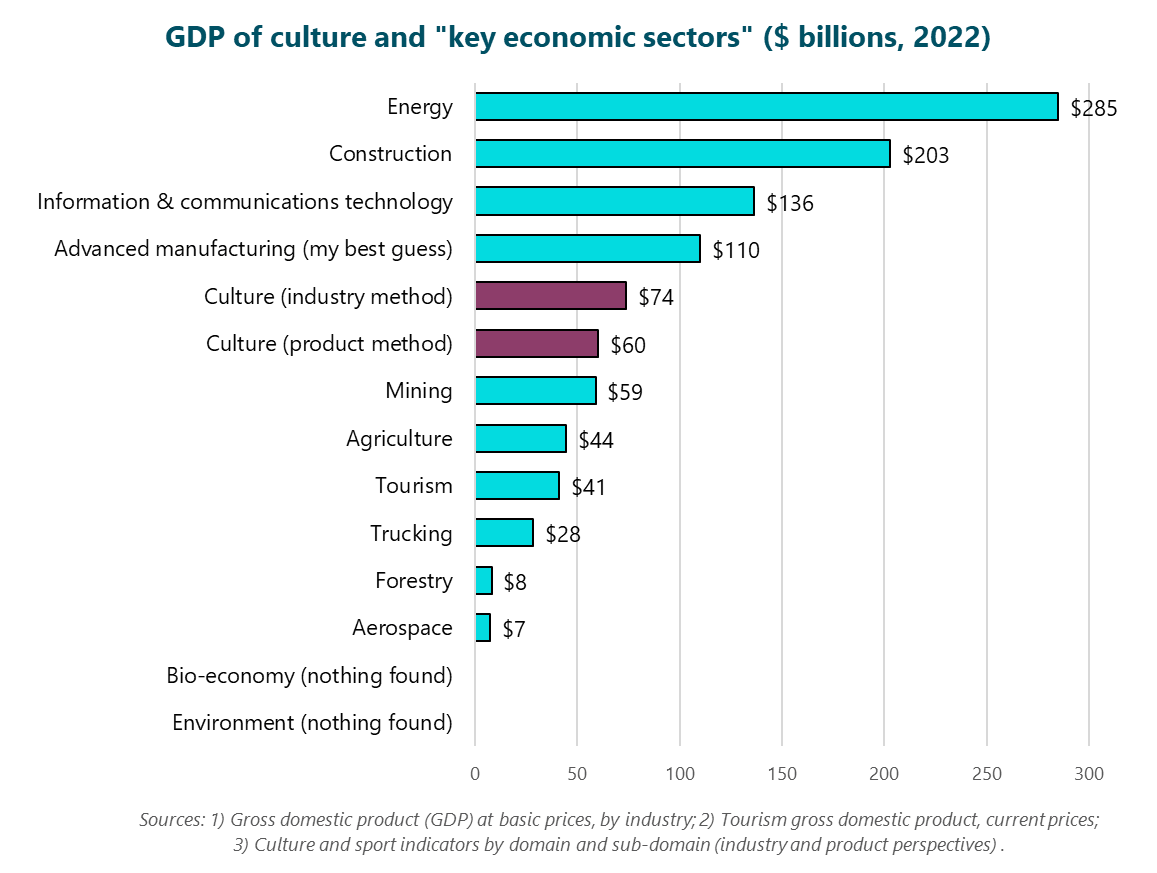
Once again, these represent only the direct economic impacts, not additional economic impacts and certainly not the myriad other social and environmental impacts of some of these sectors, including culture.
Notes
Sources:
Statistics Canada, Table 36-10-0453-01, Culture and sport indicators by domain and sub-domain, by province and territory, industry perspective and Table 36-10-0452-01, Culture and sport indicators by domain and sub-domain, by province and territory, product perspective
Statistics Canada, Table 36-10-0234-02, Tourism gross domestic product, current prices
Statistics Canada, Table 36-10-0710-01, Gross domestic product (GDP) at basic prices, by industry, annual average
The cultural statistics in today’s post are very broad: for the overall cultural sector (which I also call “the arts, culture, and heritage”). These statistics include all nine areas captured in Statistics Canada’s economic data, including six main areas (called “domains” by Statistics Canada):
Live performance (including performing arts as well as cultural festivals and celebrations, excluding government-owned organizations, which are captured in “governance, funding, and professional support”.)
Visual and applied arts (including architecture, advertising, crafts, design, and works of art)
Written and published works (including books, newspapers, periodicals, and other published works)
Audiovisual and interactive media (including broadcasting, film and video, and interactive media, excluding government-owned organizations, which are captured in “governance, funding, and professional support”)
Sound recording (and music publishing)
Heritage and libraries (including non-government-owned libraries, archives, cultural heritage, and natural heritage. Government-owned organizations are captured in “governance, funding, and professional support”.)
Also included are three supporting domains:
Governance, funding, and professional support (including, among other items, all government-owned cultural venues, which are therefore not counted in other areas, e.g., heritage and libraries, live performance, visual and applied arts, etc.).
Education and training (including cultural programs offered at educational and training establishments)
Multi domain (including items that could not be allocated to a specific domain)
The GDP estimates related to culture industries represent the net value added of the production of cultural and non-cultural goods and services by establishments within the arts, culture, and heritage.
The GDP estimates related to culture products represent the net value added of the production of cultural goods and services from establishments in both cultural and non-cultural industries.