
In every province, employees in the arts, culture, and sports are much more likely to have multiple jobs than other workers
Also: Variations in the multiple job holding rate between larger and smaller provinces

Last week, I examined the nationwide data on multiple job holding in the arts, culture, and heritage. This week, I analyze available and reliable data for the provinces. I have had to include some sports occupations in the provincial analysis, because of the limited data reliability of the more specific data for only those employees in the arts, culture, and heritage.
The article is based on data from the Labour Force Survey, which provides annual averages for workers with an employment position, not those who are self-employed in their main job.
In the 10 provinces, the proportion of employed workers in the arts, culture, and sports having multiple jobs varies between 10% and 13%. In comparison, the proportion of all employed workers having multiple jobs varies between 4% and 7%. I also examine whether arts, culture, and sports workers in smaller or larger provinces are more likely to hold multiple jobs.
Occupational groupings
Because of its relatively small sample size, the Labour Force Survey provides summary data only for arts, culture, and sports workers in most provinces. The summary data relate to what Statistics Canada calls “occupations in the arts, culture, recreation, and sports, except management”. I have estimated that roughly 75% to 80% of people in this broad occupation grouping work in the arts, culture, and heritage.
Within this broad occupational category, there are four occupation groupings. In Statistics Canada’s language, these are:
Professional occupations in the arts and culture, which include: some artists, such as producers, directors, conductors, and musicians; writers, translators, and other communications professionals; as well as librarians, archivists, conservators, and curators.
Technical occupations in the arts and culture, including: graphic and interior designers; as well as technical workers in libraries, archives, motion pictures, broadcasting, and the performing arts.
Other occupations in the arts, culture, and sports, including: artists such as dancers, actors, comedians, circus performers, photographers, craftspeople, and visual artists; theatre and fashion designers; select museum and art gallery jobs (e.g., registrars, restorers); assistants in film, broadcasting, photography, and performing arts; as well as a few sports occupations (athletes, coaches, and referees).
Support occupations in the arts, culture, and sports, including: program leaders and instructors in recreation, sport, and fitness; as well as puppeteers, buskers, magicians, portrayers of Santa Claus, influencers, and models. The recreation and sports workers in this occupational grouping greatly outnumber the cultural workers (which is why I did not include this grouping in my nationwide article).
I analyzed the first three groupings in my nationwide article, which showed an overall multiple job holding rate of 9.9% in the arts, culture, and heritage in 2025. The second estimate, relying on the broader grouping of arts, culture, and sports workers, is very similar: 10.3% in 2025. The similarity is not surprising, given the predominance of arts, culture, and heritage workers in this broader grouping, but it should provide extra confidence in provincial estimates that are based on the broader grouping. In other words, don’t worry too much about the recreation and sports workers in the broader category.
For the three largest provinces (only), the multiple job holding statistics are reliable for the first three of these detailed groupings, the ones that contain the most cultural workers. My analysis of this information follows the presentation of the summary data for all provinces.
For today’s article, I have created three-year averages to minimize the impact of unusual single year estimates in many provinces. The data in this article (labelled 2025) represent the average for 2023-2025. Because of the use of three-year averages, the Canadian data in this article might differ slightly from the article distributed a week ago.
In every province, employees in the arts, culture, and sports are much more likely to have multiple jobs than other workers
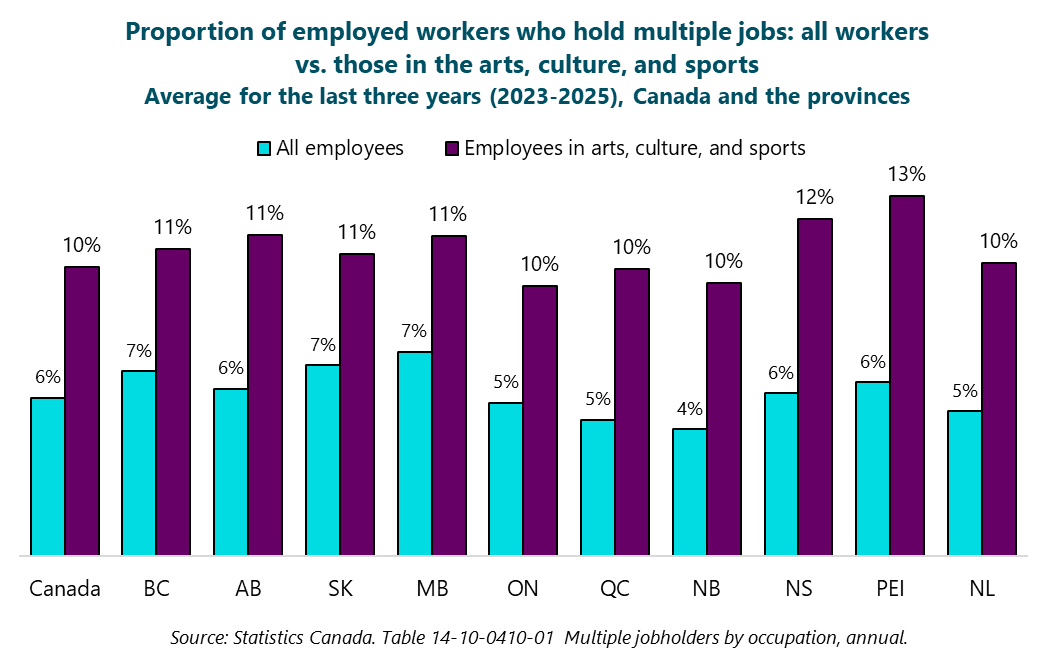
Today’s first graph provides a comparison of the proportion of employed workers in each province (overall and in the arts, culture, and sports) holding multiple jobs, based on an average of the three most recent years (2023-2025).
The key takeaway from this graph is that, in each province, the rate of multiple job holding is much higher in the arts, culture, and sports than in the rest of the economy. The proportion of employed workers in the arts, culture, and sports having multiple jobs varies between 10% and 13%. In comparison, the proportion of all employed workers having multiple jobs varies between 4% and 7%.
10% is the multiple job holding rate in the arts, culture, and sports in Ontario, Quebec, New Brunswick, and Newfoundland and Labrador, equal to the national average. Six provinces are above the national average (11% in British Columbia, Alberta, Saskatchewan, and Manitoba; 12% in Nova Scotia; and 13% in Prince Edward Island). No province is a full percentage point below the national average. (I have rounded all of the statistics to the nearest percentage point.)
Multiple job holding in the arts, culture, and sports tends to be more common in the smaller provinces
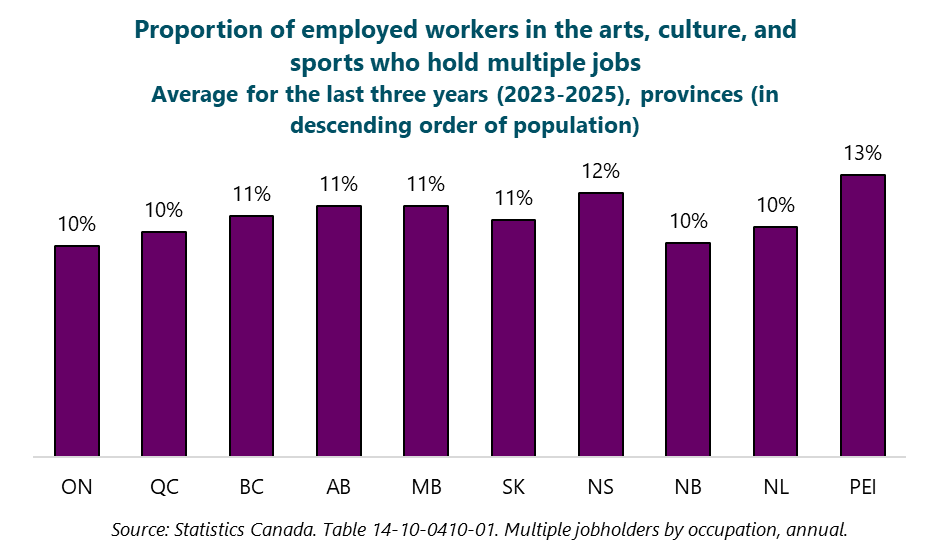
A few years ago, I analyzed this dataset to examine whether arts, culture, and sports workers in larger or smaller provinces are more likely to hold multiple jobs. I found that the largest provinces had the lowest rates of multiple job holding in the arts, culture, and sports.
The graph below presents the three year average of multiple job holding in the arts, culture, and sports. To emphasize the results, the provinces are sorted from largest to smallest populations. The data are not quite as conclusive as a few years ago, but the largest provinces do tend to have slightly lower rates of multiple job holding in the arts, culture, and sports than most smaller provinces.
Unfortunately, the Labour Force Survey doesn’t have a large enough sample size to examine these statistics for municipalities in each province.
Detailed information for the three largest provinces
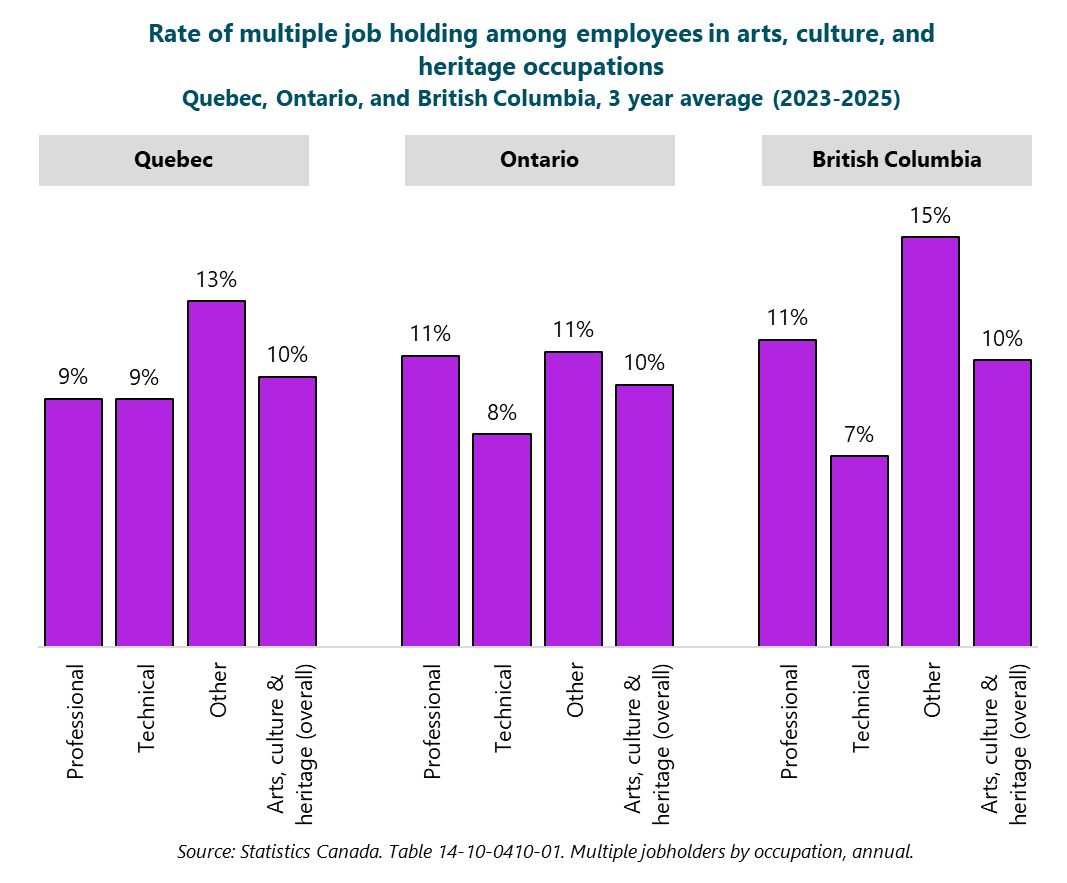
The following graph shows the multiple job holding rates in detailed arts, culture, and heritage occupation groupings in Quebec, Ontario, and British Columbia, based on a three year average from 2023 to 2025. This analysis excludes sports workers, because all sports workers are in a fourth occupational category that is not included in this section.
In Ontario and BC, the multiple job holding rates are lower for employed technical workers than for the two other occupation groupings.
The rates are:
9% in Quebec, 11% in Ontario, and 11% in BC for Statistics Canada’s grouping of professional occupations in the arts, culture, and heritage (including some artists, such as producers, directors, conductors, and musicians; writers, translators, and other communications professionals; as well as librarians, archivists, conservators, and curators).
9% in Quebec, 8% in Ontario, and 7% in BC for Statistics Canada’s grouping of technical occupations in the arts, culture, and heritage (including technical workers in libraries, archives, motion pictures, broadcasting, and the performing arts, as well as graphic and interior designers).
13% in Quebec, 11% in Ontario, and 15% in BC for Statistics Canada’s third grouping (labelled as “other”) of occupations in the arts, culture, and sports (including artists such as dancers, actors, comedians, circus performers, photographers, craftspeople, visual artists; theatre and fashion designers; select museum and art gallery jobs; assistants in film, broadcasting, photography, and performing arts; as well as sports athletes, coaches, and referees).
10% in all three provinces for all employees in these three groupings of arts, culture, and heritage occupations.
Data sources
Main dataset: Statistics Canada. Table 14-10-0410-01. Multiple jobholders by occupation, annual, https://www150.statcan.gc.ca/t1/tbl1/en/tv.action?pid=1410041001.
To calculate multiple job holding rates, the counts available in the above dataset were divided by the total number of employees in Statistics Canada. Table 14-10-0411-01. Job tenure by occupation, annual, https://www150.statcan.gc.ca/t1/tbl1/en/tv.action?pid=1410041101.