
Multiple job holding is much more common in the arts, culture, and heritage than elsewhere
Plus: Changes since 1987 and comparisons between women and men

As I have noted in the past, if driven by need rather than personal choice, multiple job holding can be an aspect of the precarity of workers in the arts, culture, and heritage. Today’s article examines the prevalence of multiple job holding for employees in different types of positions in the arts, culture, and heritage. Plus, I offer comparisons between cultural workers and the averages for all Canadian workers, as well as between women and men. I also examine changes in multiple job holding since 1987. This article, similar to my research from two years ago, uses data from the Labour Force Survey (annual averages for 2025).
Readers should be aware that the Labour Force Survey excludes self-employed workers. Because artists have very high self-employment rates, many of them are excluded from the data, as are other self-employed cultural workers. However, those self-employed artists and cultural workers who have an employed position in their main job are included.
In this article, the phrase “workers in the arts, culture, and heritage” relates to the combined total for three occupation groupings that are readily available from Statistics Canada: 1) professional occupations; 2) technical occupations; and 3) other occupations. Information about these broad groups of occupations, representing about 465,000 employees, is provided at the end of the article.
Because of its relatively small sample size, the Labour Force Survey doesn’t allow me to pinpoint specific occupations, even looking at annual averages. That is why I’m sticking with the three readily available groupings of arts, culture, and heritage employees.
Today’s article examines the nationwide picture, and a provincial analysis is planned for next week.
About 10% of employees in the arts, culture, and heritage have multiple jobs, which is close to double the rate among employees in all industries. Multiple job holding in the arts, culture, and heritage has tended to increase over time.
Employees in the arts, culture, and heritage are nearly twice as likely to have multiple jobs than other workers
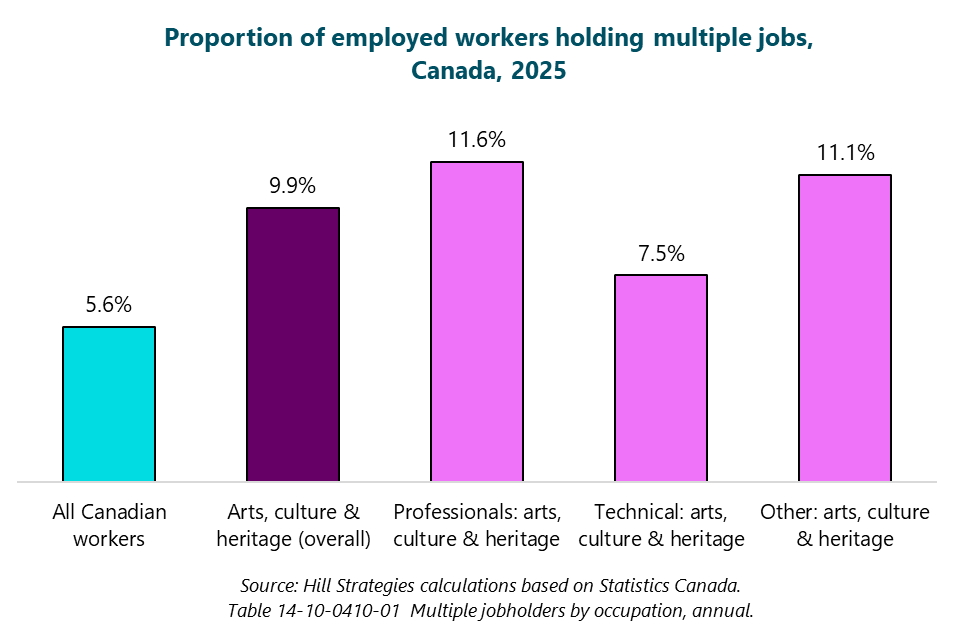
Employees in the arts, culture, and heritage are much more likely to accumulate multiple jobs than other workers, as shown in the following graph. One in every 10 employees in the arts, culture, and heritage had multiple jobs in 2025, compared with just 5.6% of all Canadian employees. In other words, the multiple job holding rate is 77% higher in the arts, culture, and heritage than for other workers.
The graph also shows that, among broad groupings of employed workers in the arts, culture, and heritage, technical workers are least likely to have multiple jobs. The percentage of employees working multiple jobs is:
11.6% for Statistics Canada’s grouping of professional occupations in the arts, culture, and heritage (including some artists, such as producers, directors, conductors, and musicians; writers, translators, and other communications professionals; as well as librarians, archivists, conservators, and curators).
7.5% for the grouping of technical occupations in the arts, culture, and heritage (i.e., technical workers in libraries, archives, motion pictures, broadcasting, and the performing arts, as well as graphic and interior designers).
11.1% for the third grouping of occupations in the arts, culture, and sports (including artists such as dancers, actors, comedians, circus performers, photographers, craftspeople, visual artists; theatre and fashion designers; select museum and art gallery jobs; assistants in film, broadcasting, photography, and performing arts; as well as sports athletes, coaches, and referees).
Multiple job holding in the arts, culture, and heritage has tended to increase over time
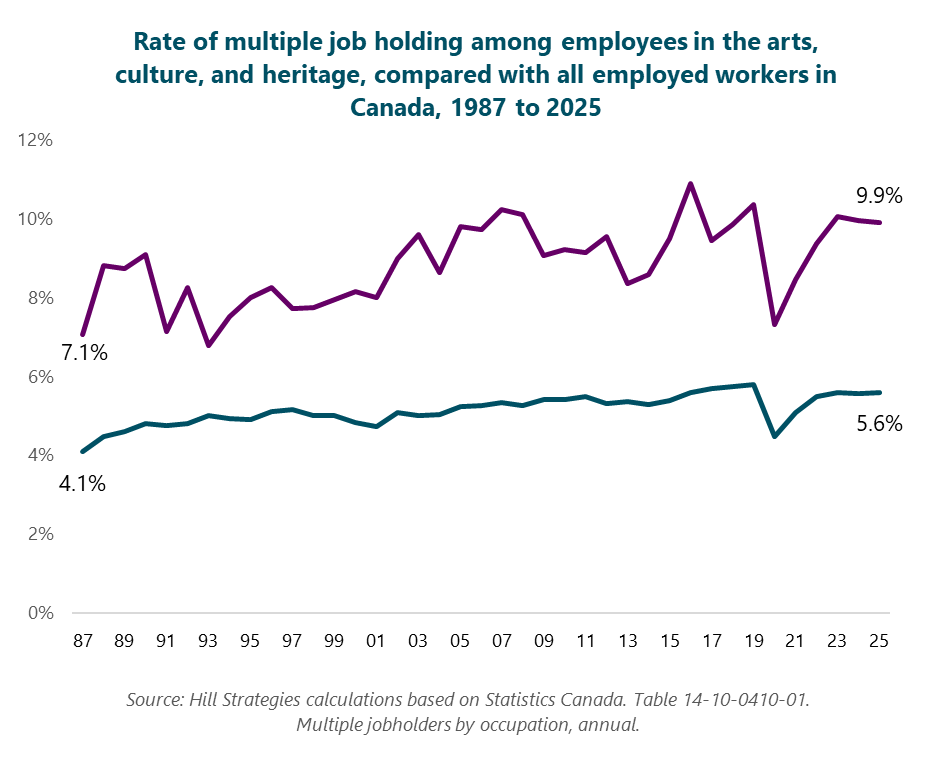
The percentage of arts, culture, and heritage employees holding multiple jobs was much higher in 2025 (9.9%) than in 1987 (7.1%), as shown in the following graph. The multiple job holding rate appears to have returned to rates near or above 10% that were more common before the pandemic. The multiple job holding rate had reached a 25-year low of 7.3% in 2020 (when it was difficult for many cultural workers to have even one job).
The graph shows that the multiple job holding rate in the arts, culture, and heritage did not reach 10% during the first 20 years of data collection (from 1987 to 2006). The rate has ticked above 10% in five years since then: 10.2% in 2007, 10.1% in 2008, 10.9% in 2016, 10.4% in 2019, and 10.1% in 2023. The level in 2025 is just one percentage point below the 10% threshold.
The graph also shows how the multiple job holding rate in the arts, culture, and heritage has always remained above the national average. In fact, the difference has increased from 3.0% in 1987 to 4.3% in 2025.
In culture, men are more likely than women to hold multiple jobs
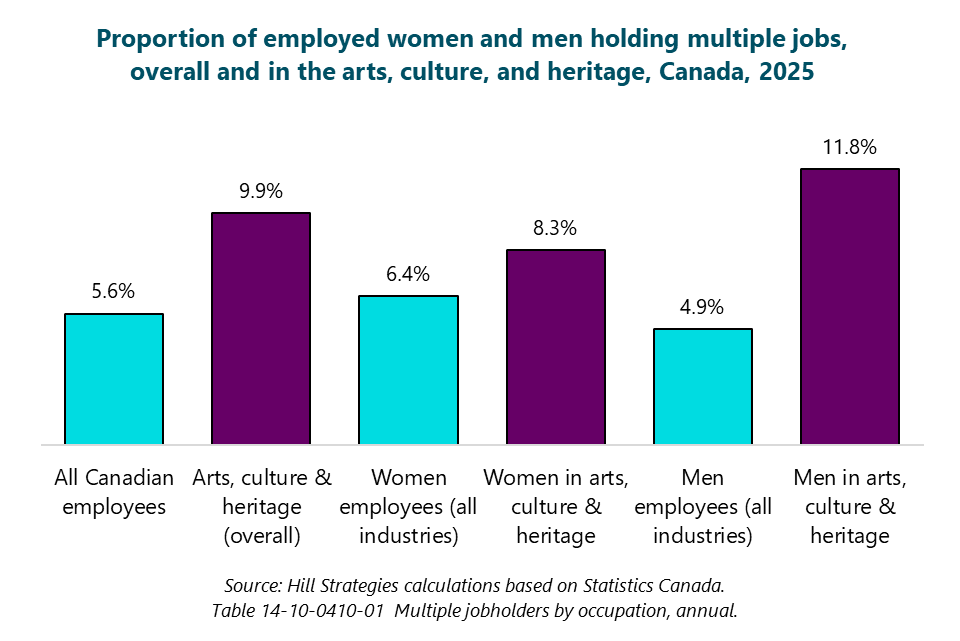
In 2025, the multiple job holding rate was higher among women than men in the overall economy, but the reverse was true in the arts, culture, and heritage. Overall, 6.4% of employed women have multiple jobs, compared with 4.9% of men, as shown in the following graph. In the arts, culture, and heritage, 8.3% of employed women have multiple jobs, compared with 11.8% of men.
Data sources and notes
The main dataset is Statistics Canada. Table 14-10-0410-01. Multiple jobholders by occupation, annual, https://www150.statcan.gc.ca/t1/tbl1/en/tv.action?pid=1410041001.
The total number of employed workers in each occupation grouping was drawn from Statistics Canada. Table 14-10-0411-01. Job tenure by occupation, annual, https://www150.statcan.gc.ca/t1/tbl1/en/tv.action?pid=1410041101. This dataset was also used to calculate multiple job holding rates (by dividing the count of multiple jobholders by the total number of employees).
Readily available occupation groupings
The three arts, culture, and heritage occupation groupings in the dataset include 464,700 employed workers. There are a few sport workers in one of the occupation groupings, but I estimate that 95% of the combined number of workers in the three occupation groupings work in the arts, culture, and heritage.
The three occupation groupings include:
175,500 employed workers in what Statistics Canada calls professional occupations in the arts and culture, which include: some artists, such as producers, directors, conductors, and musicians; writers, translators, and other communications professionals; as well as librarians, archivists, conservators, and curators.
175,500 employed workers in what Statistics Canada calls technical occupations in the arts and culture, including: graphic and interior designers; as well as technical workers in libraries, archives, motion pictures, broadcasting, and the performing arts. (Coincidentally, there are the same number of professional and technical workers in the arts, culture, and heritage in 2025.)
113,700 employees in what Statistics Canada (rather generically) calls occupations in the arts, culture, and sports, including: artists such as dancers, actors, comedians, circus performers, photographers, craftspeople, and visual artists; theatre and fashion designers; select museum and art gallery jobs (e.g., registrars, restorers); assistants in film, broadcasting, photography, and performing arts; as well as a few sports occupations (athletes, coaches, and referees).
By my estimate, using the granular data that are available in the 2021 census, these three occupation groupings account for about two-thirds of all cultural workers. (The cultural workers who are not covered by the data are mostly those who work in disparate areas of the economy, such as printing, advertising, and architecture.) Unfortunately, the census does not address multiple job holding, and I therefore cannot take advantage of the larger sample size of the census to examine this issue at a more granular level.
As always, Kelly, thanks for an informative article. Is there any way to determine whether the growing # of people with multiple jobs might point to a shift in the sector away from full-time positions towards part-time or part-year work? Thanks!