

Today, as part of my series of articles analyzing local statistics on workers in arts, culture, heritage, and some sport occupations, I examine individual and group changes between 2013 and 2025 for 7 CMAs with populations between 500,000 and 1,000,000: Winnipeg, Quebec City, Hamilton, Kitchener-Cambridge-Waterloo, London, Halifax, and St. Catharines-Niagara. For comparison purposes, I’ll include an analysis of the Canada-wide change between 2013 and 2025.
Last week, I examined the trends for Canada, the 31 CMAs (as a group), and the 6 largest CMAs: Calgary, Edmonton, Montreal, Ottawa-Gatineau, Toronto, and Vancouver.
In upcoming articles, I’ll analyze smaller CMAs: 1) the 10 CMAs with populations between 220,000 and 500,000; and 2) the 8 CMAs with populations under 200,000. The 18 CMAs to come in future articles are: Abbotsford-Mission, Barrie, Fredericton, Greater Sudbury, Guelph, Kelowna, Kingston, Moncton, Oshawa, Peterborough, Regina, Saint John, Saskatoon, Sherbrooke, St. John’s, Trois-Rivières, Victoria, and Windsor.
These articles are based on publicly available occupation statistics from the Labour Force Survey (LFS). As was the case last week, I have created three-year averages to provide a higher level of statistical reliability and minimize the impact of unusual single year estimates in many CMAs. The data in this article labelled 2025 therefore represent the average for 2023-2025. The earliest data point (labelled 2013) is actually the average for 2011-2013. This technique is similar to what I did in my recent analysis of multiple job holding by province.
Key things to know about the Labour Force Survey
In my opinion, data from the Labour Force Survey are useful but imperfect for analyzing the labour force in the arts, culture, and heritage. I outline many limitations at the end of this article and in even greater detail here.
Because of its relatively small sample size, the Labour Force Survey can only offer reliable local data for a broad category of arts, culture, heritage, and sports workers. The summary data relate to what Statistics Canada calls “occupations in the arts, culture, recreation, and sports, except management”. I will generally call this occupation category “arts, culture, heritage, and sport workers”. Details about the occupation groupings within this category are at the end of this article.
Most of the people in this category (roughly 75%) work in the arts, culture, and heritage (rather than sports and recreation). The category covers approximately 60% of all workers in the arts, culture, and heritage.
The data are available for CMAs, not for municipalities per se.
Given the Labour Force Survey’s limitations, the analysis that follows is relatively simple: I examine whether the number of workers in the selected occupation grouping has increased or decreased over 12 years or so.
Reminder of Canada-wide data
There has been a relatively consistent increase in the number of workers in the arts, culture, heritage, and sport in Canada, resulting in a 26% increase between 2013 (estimate of 510,000) and 2025 (641,000). The exception to the increases was between 2020 and 2022, but there has been a solid increase since 2022.
7 CMAs with populations between 500,000 and 1 million
5.1 million people, or 12% of Canada’s population, reside in the 7 CMAs analyzed in today’s article.
12% of all Canadian workers in the arts, culture, heritage, and sport (79,000 people) reside in these 7 CMAs, a percentage that is equal to the CMAs’ share of the population.
Between 2013 and 2025, the 30% increase in number of workers in the arts, culture, heritage, and sport in the 7 CMAs is slightly above to the Canadian average (26%). Most of the increase has occurred since 2022, as shown in the following graph. Collectively, in the 7 CMAs, there were 60,000 workers in this occupation grouping in 2013, 61,000 in 2022, and 79,000 in 2025.
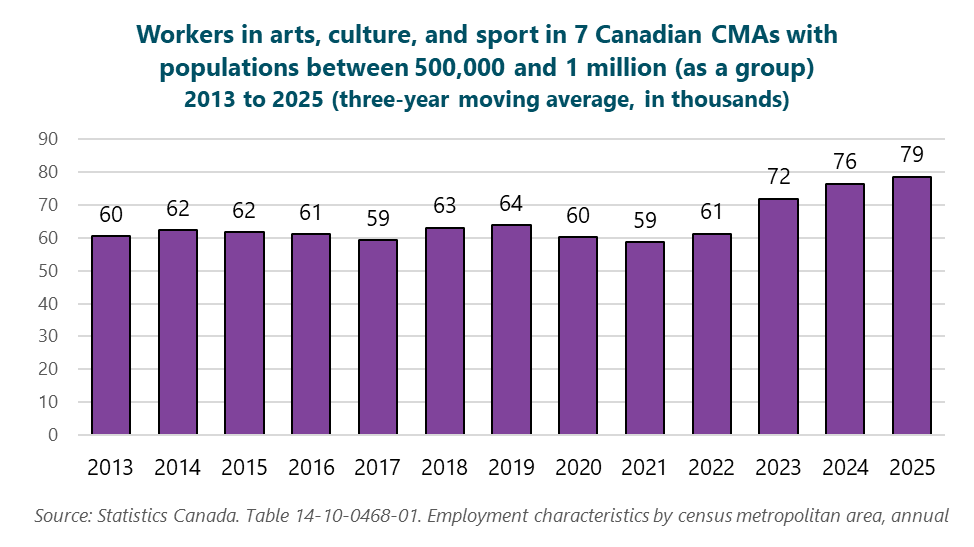
All 7 CMAs saw increases in the number of workers in the arts, culture, heritage, and sport. Only 2 had increases that were below the national average (26%).
Details follow for each of the 7 CMAs, from largest to smallest.
Winnipeg CMA
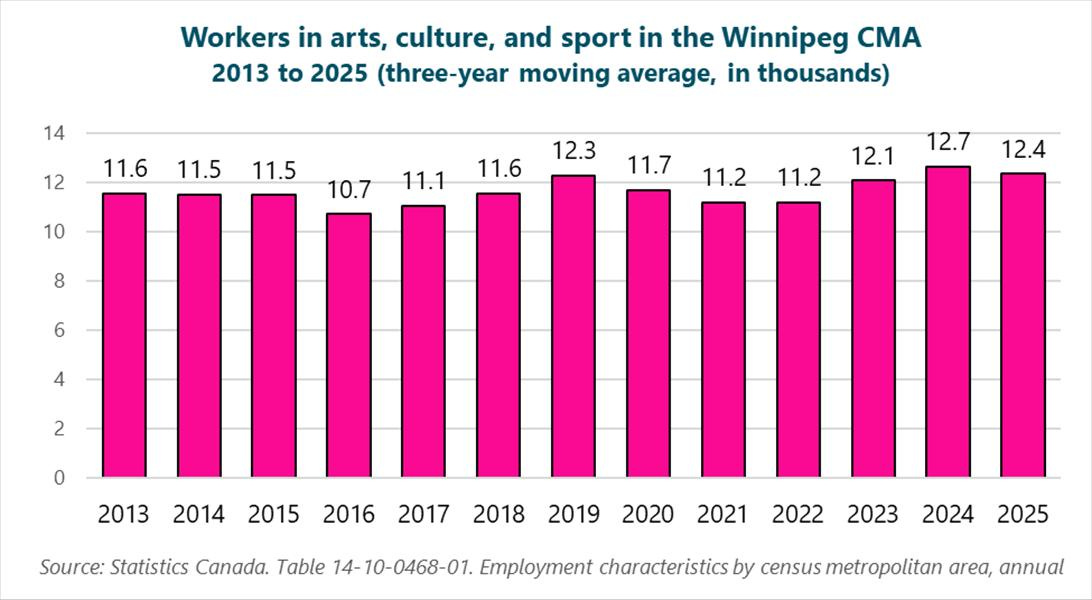
In the Winnipeg Census Metropolitan Area (population of 952,000 in 2025), the number of workers in the arts, culture, heritage, and sport increased by 7% between 2013 and 2025, the lowest increase among the 7 CMAs in today’s article. The estimates were 11,600 in 2013 and 12,400 in 2025.
Quebec City CMA
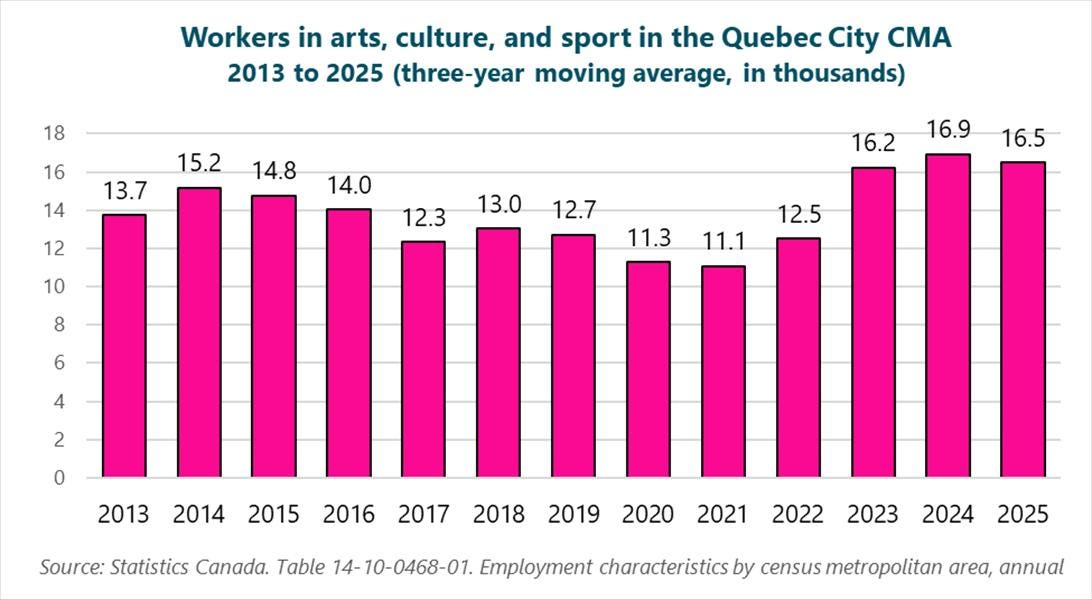
Between 2013 and 2025, the number of workers in the arts, culture, heritage, and sport in the Quebec City CMA (population of 904,000 in 2025) increased inconsistently but saw particularly strong growth since 2022. There were 13,700 workers in this occupation grouping in 2013 and 16,500 in 2025, representing a 20% increase over this timeframe.
Hamilton CMA
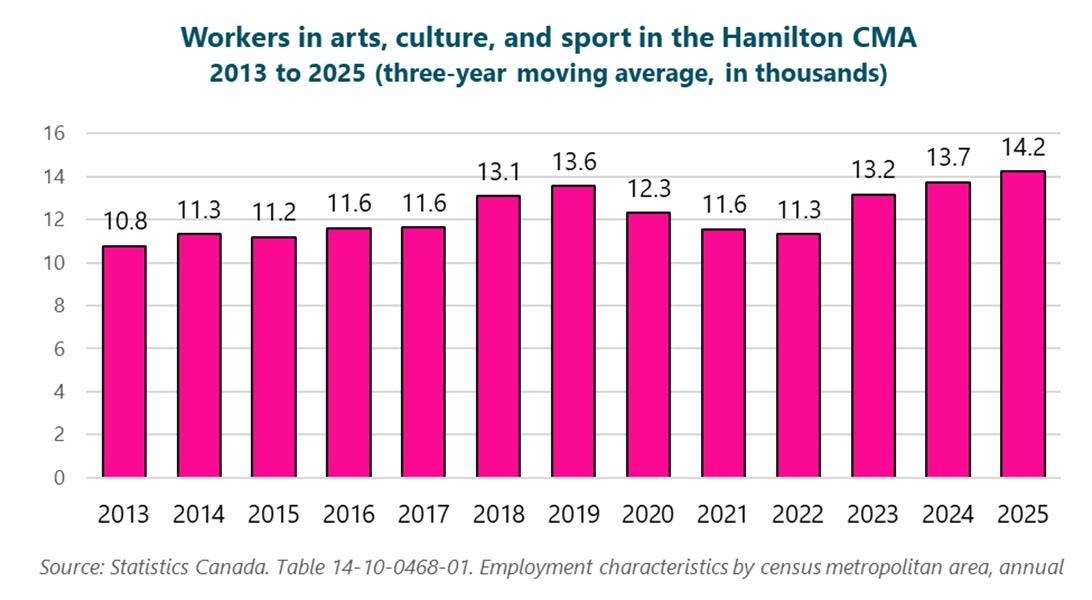
In the Hamilton CMA (population of 871,000 in 2025), the number of workers in the arts, culture, heritage, and sport increased by 32% between 2013 and 2025. There were 10,800 workers in this occupation grouping in 2013 and 14,200 in 2025.
Kitchener-Cambridge-Waterloo CMA
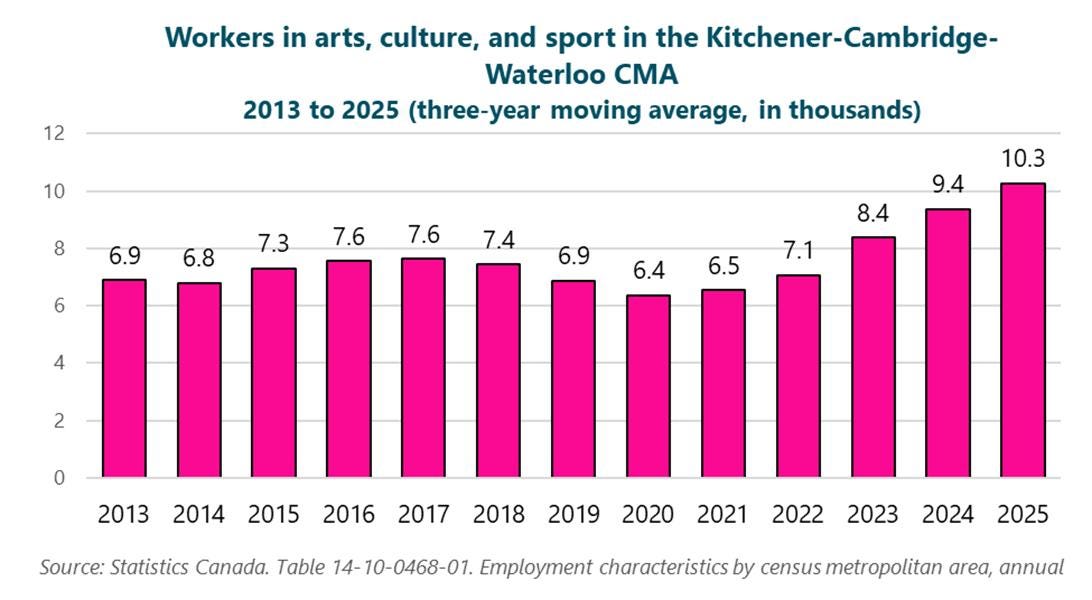
The number of workers in the arts, culture, heritage, and sport in the Kitchener-Cambridge-Waterloo CMA (population of 702,000 in 2025) increased by 49% between 2013 and 2025, with the largest increases coming since 2022. The estimates of workers in this occupation grouping were 6,900 in 2013 and 10,300 in 2025.
London CMA
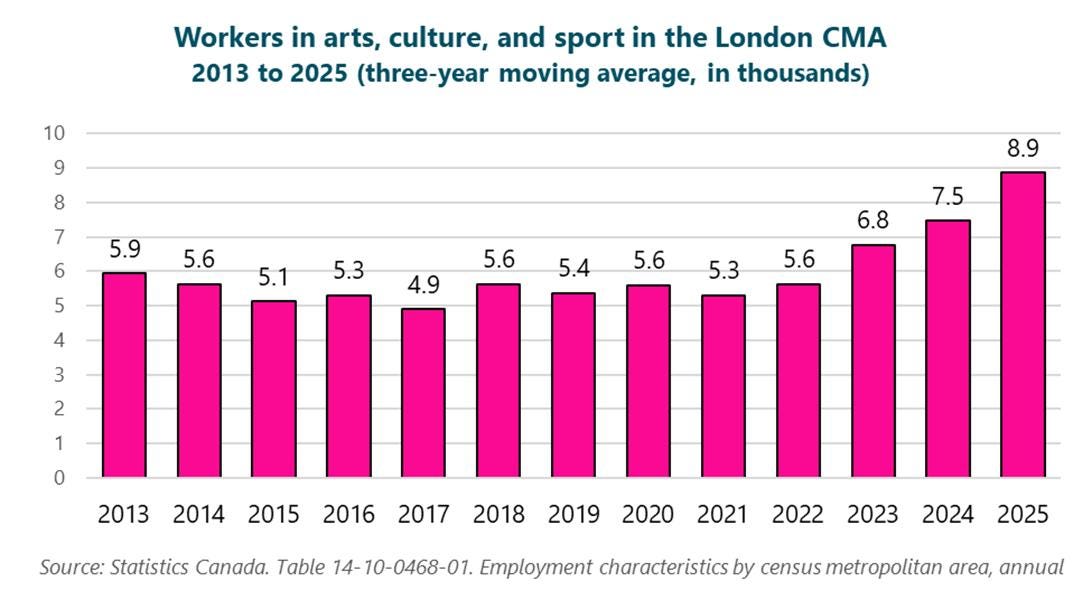
In the London CMA (population of 633,000 in 2025), the number of workers in the arts, culture, heritage, and sport showed only small changes between 2013 and 2022 but has increased significantly since then. The estimate in 2025 (8,900) is 49% higher than the estimate in 2013 (5,900).
Halifax CMA
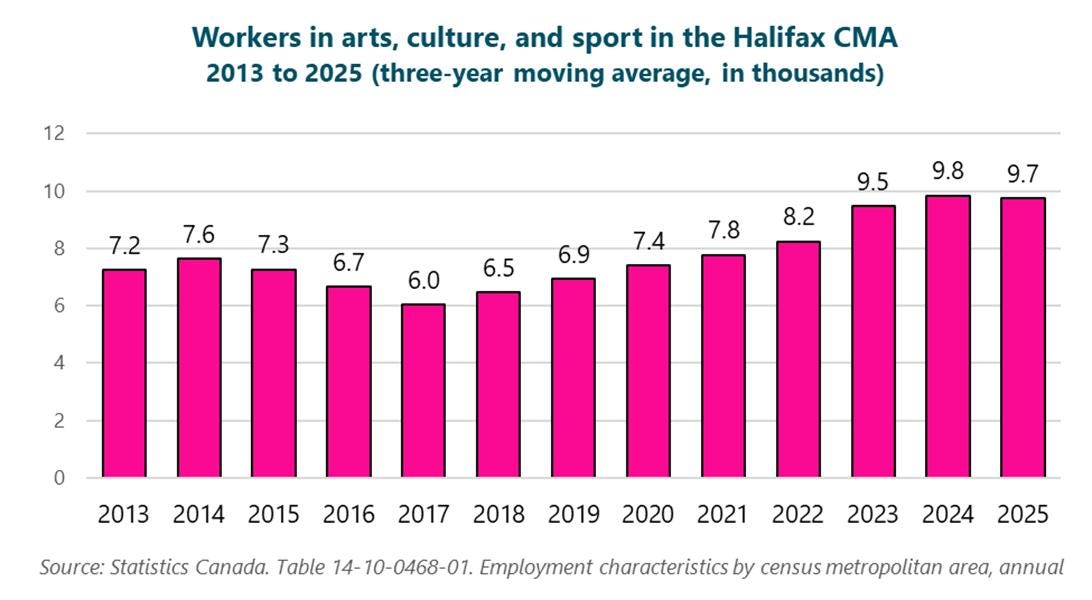
In the Halifax CMA (population of 545,000 in 2025), the number of workers in the arts, culture, heritage, and sport has increased consistently since 2017, after some decreases early in the period covered in the following graph. There were 7,200 workers in this occupation grouping in 2013 and 9,700 in 2025, representing a 35% increase.
St. Catharines-Niagara CMA
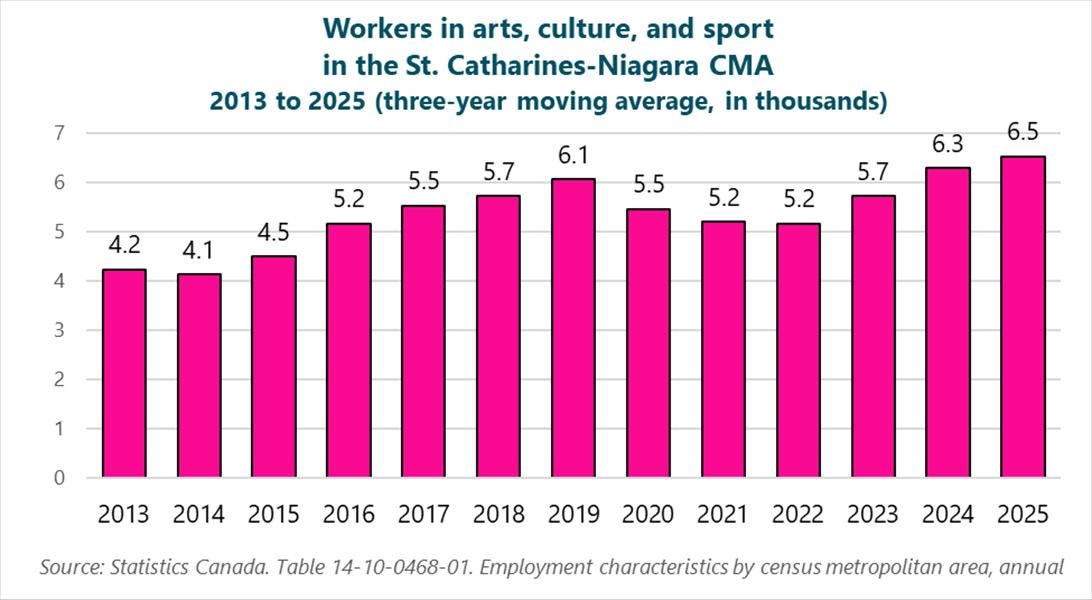
In St. Catharines-Niagara (population of 504,000 in 2025), the number of workers in the arts, culture, heritage, and sport increased between 2013 and 2019 but then decreased sharply during the pandemic. The rebound since 2022 has brought the estimate of workers in this occupation grouping to 6,500 in 2025, which is 54% higher than the estimate in 2013 (4,200). This is the largest longer term increase among the 7 CMAs in today’s article.
Data sources and notes
Statistics Canada. Table 14-10-0468-01. Employment characteristics by census metropolitan area, annual. https://www150.statcan.gc.ca/t1/tbl1/en/tv.action?pid=1410046801
Population statistics are drawn from Statistics Canada. Table 17-10-0148-01. Population estimates, July 1, by census metropolitan area and census agglomeration, 2021 boundaries, https://www150.statcan.gc.ca/t1/tbl1/en/tv.action?pid=1710014801
Why analyze the Labour Force Survey?
I’ve analyzed this dataset (now), rather than the census (which has a much larger sample size) because of timeliness and easy availability. The strength of the Labour Force Survey is its frequency. It is conducted monthly, but the local cultural estimates would not be reliable on a monthly basis, particularly for areas with smaller populations. To counter this limitation, my analysis focuses on three-year averages (not annual or monthly data). When multiplied by 12 for each year, then by 3 for the three-year averages, the sample sizes become more interesting.
The Labour Force Survey data can show us trends that the census, conducted only every five years, cannot. In addition, occupation data from the census is published roughly a year and a half after the census is conducted. We will probably be waiting until late 2027 for labour force data from the census in May of 2026.
Occupational categories
The data in this article relate to what Statistics Canada calls “occupations in the arts, culture, recreation, and sports, except management”. Most of the people in this category are cultural workers: I have estimated that roughly 75% to 80% of people in this broad occupation grouping work in the arts, culture, and heritage. And the category covers most (but certainly not all) cultural workers: I have estimated that the workers in this broad occupation grouping account for roughly 60% of all workers in the arts, culture, and heritage. (Further details, including a thorough discussion of LFS limitations, is available here.)
Within this broad occupational category, there are four occupation groupings. In Statistics Canada’s language, these are:
Professional occupations in the arts and culture, which include: some artists, such as producers, directors, conductors, and musicians; writers, translators, and other communications professionals; as well as librarians, archivists, conservators, and curators.
Technical occupations in the arts and culture, including: graphic and interior designers; as well as technical workers in libraries, archives, motion pictures, broadcasting, and the performing arts.
Other occupations in the arts, culture, and sports, including: artists such as dancers, actors, comedians, circus performers, photographers, craftspeople, and visual artists; theatre and fashion designers; select museum and art gallery jobs (e.g., registrars, restorers); assistants in film, broadcasting, photography, and performing arts; as well as a few sports occupations (athletes, coaches, and referees).
Support occupations in the arts, culture, and sports, including: program leaders and instructors in recreation, sport, and fitness; as well as puppeteers, buskers, magicians, portrayers of Santa Claus, influencers, and models. The recreation and sports workers in this occupational grouping greatly outnumber the cultural workers (which is why I exclude this grouping whenever possible).
LFS limitations (in brief)
Earnings data are not available in the summary dataset published by Statistics Canada. For the cultural sector, this is not a big loss, because the LFS questionnaire captures salaries only, not self-employment earnings. (That’s the more important limitation for the cultural sector and for other sectors where self-employment is common.)
Other important limitations of the LFS:
People’s description of their main job during the reference period is used to classify them into occupations. Some data on secondary occupations is available but is not covered in this report.
It doesn’t have a large enough sample size to delve into the details for individual occupation groupings in Census Metropolitan Areas, which is why the broad category is helpful.
It captures data on Indigenous workers only every three months and only started capturing data on racialized workers in the summer of 2020.
No data are available for 2SLGBTQIA+, D/deaf, and disabled workers.
Neither the LFS nor the census can provide insights into the reasons behind statistical trends.