

For this week’s article, I’ve analyzed datasets and reports on donors, donations, and sponsorships in Canada – for all sectors, not just the arts. In coming weeks, I’ll examine what the data say about the arts.
Inflation has affected charitable organizations’ expenditures and, along with other factors, the ability and willingness of many Canadians to donate to charities. Indeed, there has been a steady decline in the number of donors. Despite this, the value of donations has increased. Sponsorship levels appear to have increased, based on findings from a relatively small survey with shifting respondent numbers and types. Do these trends leave organizations more vulnerable to a potential economic downturn, the loss of key donors, the loss of an important sponsor, or other surprises?
The article is based on multiple data sources:
Individuals’ tax filings (which is an important data source but cannot be broken down into the types of organizations supported, because not every taxfiler submits the full details of their donations)
A Statistics Canada survey of individual donors (which can be broken down by type of recipient organization but has a moderate sample size. As a result, the margin of error of its estimates can be relatively large for smaller charitable sectors.)
A private survey of sponsorships (which has quite a small sample size but is the only source I found on this topic. The survey had 303 respondents, including sponsors, sponsorship recipients, and sponsorship agencies. Only 6% of respondents completed the survey in French, which calls into question the survey’s national representativeness.)
The first two datasets currently have 2023 as their most recent data year, while the sponsorship survey is from 2024.
1997 to 2023: Steady decline in charitable donors but an increase in the value of donations
The following graph shows that the value of charitable donations has increased substantially since 1997. In fact, charitable donations were 72% higher in 2023 than in 1997 (even after adjusting for inflation). The value of donations to all types of charities was $12.8 billion in 2023, compared with $7.4 billion in 1997 (adjusted for inflation).
More recently, the value of donations to all types of charities was slightly higher in 2023 ($12.8 billion) than before the pandemic ($11.9 billion in 2019, adjusted for inflation).
The graph also demonstrates the slow but steady decline in the number of taxfilers claiming charitable donations, resulting in a 4% decrease between 1997 and 2023. The decrease is amplified when expressed as a percentage of all taxfilers: the proportion claiming charitable donations was 26% in 1997 and 17% in 2023.
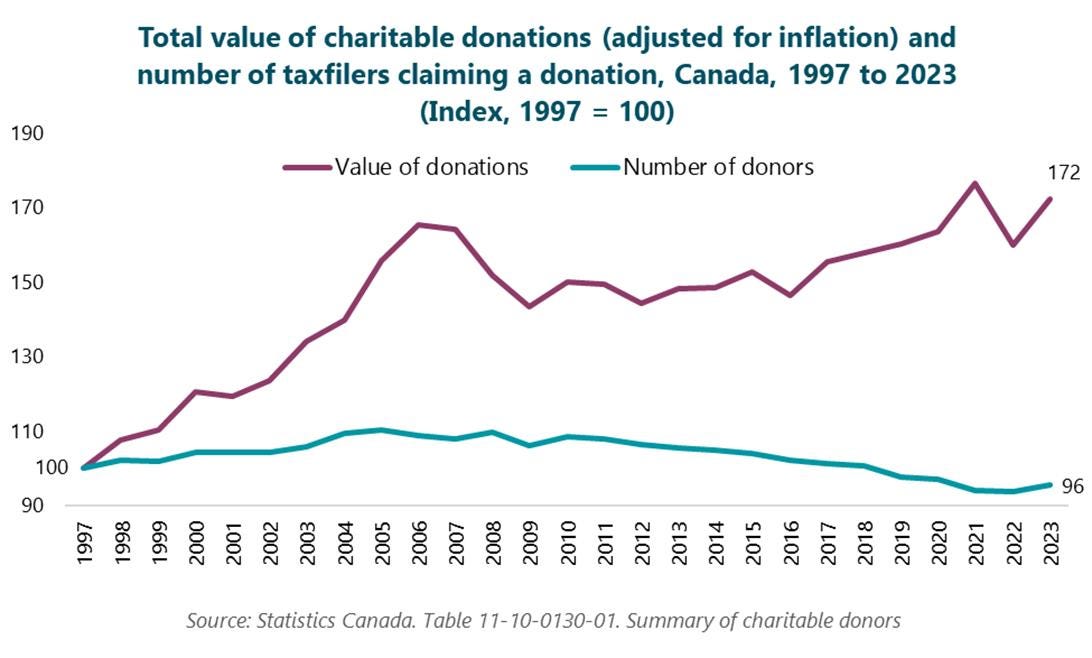
Below, I outline the key statistics in 1997 and 2023, the median and average donations between 1997 and 2023, findings from StatsCan’s survey of donors, and findings from a survey of sponsors and sponsorship recipients.
The key statistics in 1997 and 2023, with the value of donations adjusted for inflation, are:
1997: 5.3 million charitable donors, or 26% of all taxfilers. Value of donations = $7.4 billion.
2023: 5.0 million charitable donors, or 17% of all taxfilers. Value of donations = $12.8 billion. Value of donations via CanadaHelps: $450 million (which, by my calculation, is 3.5% of the total reported on Canadians’ tax returns).
In its Giving Report, CanadaHelps argues that the “growing reliance on a smaller group of committed givers leaves the sector more exposed to economic shocks, donor fatigue, and generational turnover. To build resilience, we need to invest in strategies that expand who gives, not just how much is given.”
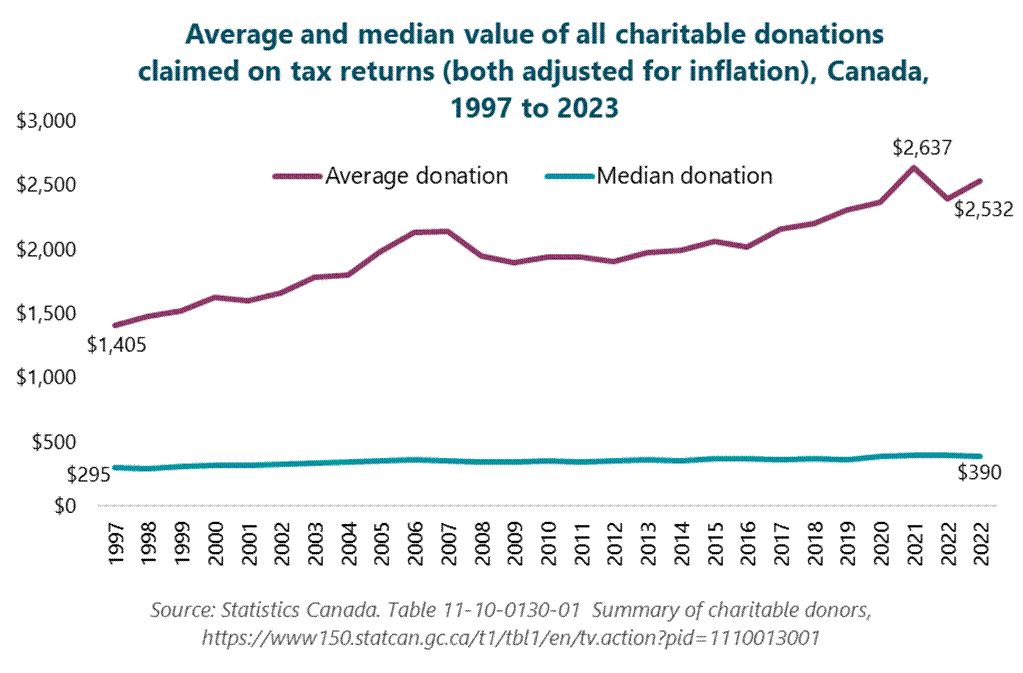
Today’s second graph shows that both the average and the median value of charitable donations have increased since 1997, with the average increasing by much more than the median. (Both sets of statistics have been adjusted for inflation.) The larger increase in the average than the median is consistent with the above finding that larger amounts of donations come from fewer donors.
The inflation-adjusted values in 1997 and 2023 are:
1997: Average donation of $1,405 and median (or typical) donation of $295.
2023: Average donation of $2,532 (80% higher than in 1997) and median donation of $390 (32% higher than in 1997).
Analytical article highlights a recent decrease in the number of donors
Statistics Canada’s analysis of its Survey of Giving, Volunteering, and Participating (SGVP) indicates that “the proportion of Canadians aged 15 and older who made a donation decreased from 68% in 2018 to 54% in 2023”.
The proportion of survey respondents indicating that they had donated money in 2023 (54%) is much higher than the proportion of taxfilers reporting a charitable donation (just 17% in 2023, as noted above).
Regarding the value of donations, the survey estimates that $13.4 billion was donated to charities and not-for-profit organizations in 2023. This estimate is reasonably close to the one based on taxfiler data ($12.8 billion, as noted above).
Statistics Canada also notes that the estimate of $13.4 billion in 2023 “was roughly the same as in 2018 ($14.0 billion in 2023 dollars)”.
The survey of donors found that about $7 of every $10 raised by organizations comes from the most generous 10% of donors. These “top donors” contributed $9.5 billion of the $13.4 billion total, or 71%.
Next week, I’ll analyze this survey’s dataset for donations to the arts, culture, and heritage.
Key findings from a sponsorship study
The Canadian Sponsorship Landscape Study covers activity in 2024, based on a sample that included 149 sponsors (“brands”), 97 recipient organizations (“properties”), and 57 sponsorship agencies. Despite its moderate sample size and imperfect representation across the country, I think that the survey still offers some interesting findings. Also, I don’t know of any other source for this type of information.
The investment that responding brands made in sponsorship fees was $2.56 billion in 2024, a 9% increase from 2019 (after adjusting for inflation). The report clearly shows that professional sports are the favourite sponsorship “property”: pro sports account for the largest share of sponsorships (overall) and of the highest value sponsorships. In two weeks, I’ll highlight the report’s findings on arts sponsorships.
The report highlights how vital relationship building is to sponsorships. In fact, about one-third of rights fees received (32%) are reinvested in the sponsorship through servicing, activation, and evaluation. The report describes and delves into each of these topics.
The report indicates that, in recent years, sponsorship relationships have focussed on improved return on investment, digital efficiencies, and AI. Other investment trends include new brands, demographic swings, and investments across more types of organizations (aka “property categories”).
Data sources
Statistics Canada, Table 11-10-0130-01, Summary of charitable donors, https://www150.statcan.gc.ca/t1/tbl1/en/tv.action?pid=1110013001
Charitable donors, 2023. Statistics Canada, The Daily, April 1, 2025, https://www150.statcan.gc.ca/n1/daily-quotidien/250401/dq250401c-eng.htm. Accompanying data tables: https://www150.statcan.gc.ca/n1/daily-quotidien/250401/dq250401c-cansim-eng.htm
Volunteering and charitable giving in Canada, 2018 to 2023. Statistics Canada, The Daily, June 23, 2025, https://www150.statcan.gc.ca/n1/daily-quotidien/250623/dq250623b-eng.htm
Trends in Charitable Giving 2018-2024: The Giving Report 2025, Canada Helps, https://www.canadahelps.org/en/the-giving-report/ (sign-in required, but the report is free)
Canadian Sponsorship Landscape Study (2024). The T1 Agency, Dr. Norm O’Reilly (Lead author). https://www.thet1agency.com/canadian-sponsorship-landscape-study/ (sign-in required, but the report is free)
It's interesting to map the spikes in charitable giving against changes in income tax legislation, including the 50% exemption on capital gains when qualifying stock was donated to registered charities (1999? 2000? somewhere in there) and again in 2006 when the exemption was raised to 100%. I wonder if there's any similar levers - through the tax system or otherwise - to incent smaller charitable gifts. I'm concerned that the HABIT of giving, once broken, doesn't return...