
Artists in Canada have consistently earned much lower incomes than other Canadian workers
Analysis of changes in average personal incomes over 30 years

Today’s article provides a careful analysis of trends in the average income of artists between 1990 and 2020 in Canada, with a comparison to all workers in the country.
In keeping with Hill Strategies’ other work from the 2021 census, 10 specific occupation groups are included as “artists”:
Actors, comedians, and circus performers
Artisans and craftspersons
Authors and writers (excluding technical writers)
Conductors, composers, and arrangers
Dancers
Musicians and singers
Other performers
Painters, sculptors, and other visual artists
Photographers
Producers, directors, choreographers, and related occupations
Because of the complexity of the background analysis as well as changes in some of the occupation groups over time, income trends for each artist occupation group are not provided in this article.
The complexity has also led to the delay in analyzing data from the 2021 census (the most recent year in today’s analysis). The 2026 census has now (mostly) been filled in by Canadian residents, but data likely won’t be available for at least 12 months, probably more like 18 months. (I have still never gotten the long-form census and have therefore never reported on my occupation.)
Because of the changes in the artist occupation groups historically (9 occupation groups, excluding photographers) compared with 2021 (10 occupation groups, including photographers), it is easier to estimate the average income of artists for each census year, including an adjustment for photographers, than the median income, which is the most common income statistic in my other articles. The average income of artists tends to be somewhat higher than the median income, because of the influence on the average of a small number of high earners. The median is less affected by these extremes.
The average income statistics in this article capture overall personal income, which includes all sources, such as employment income, net revenue from self-employment, government supports, rental income, investment income, and others. The data are not directly comparable to the average employment income of Toronto artists (in last week’s article), because employment incomes are a portion of total incomes (the statistic in today’s article). Only employment income statistics were available in my datasets for local areas.
The estimates of average incomes in this article have been adjusted for inflation. Census data on incomes offer an estimate for the prior calendar year (e.g., the 2021 census captures income estimates from 2020).
Other important notes about methods are provided at the end of the article.
The average income of Canadian artists has not kept up with other workers
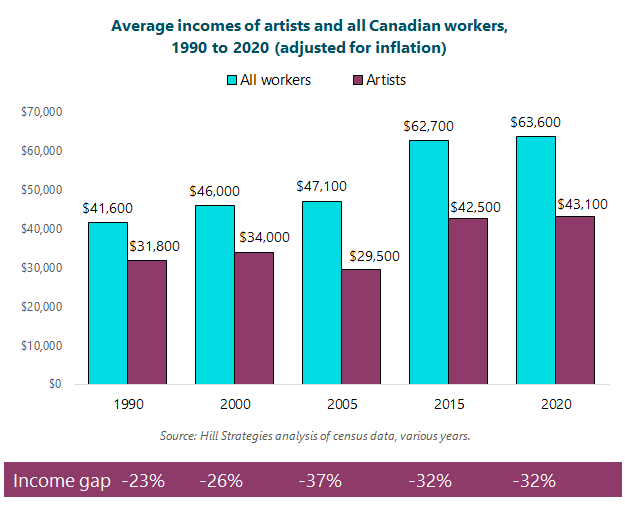
In 1990 (the earliest data year in the following graph), the average income of artists in Canada was $31,800, which was 23% below that of all Canadian workers ($41,600).
In 2020 (the most recent data year), while the average income of artists in Canada had grown to $43,100, the gap with other workers had increased to 32%.
So: the average income of artists, adjusted for inflation, has increased over the 30-year period. That’s the good news. However, the average income of other workers has increased more.
The largest change in incomes occurred between 2005 and 2015. The average income of artists increased from $29,500 in 2005 to $42,500 in 2015. However, the average income of all Canadians workers also increased significantly, from $47,100 in 2005 to $62,700 in 2015.
The largest change in the percentage difference with other workers occurred between 2000 and 2005. In 2000, the average income of artists was $34,000, or 26% less than all Canadian workers ($46,000). The difference increased to 37% in 2005, when the average income of artists was $29,500, compared with an average income of $47,100 for all workers.
The following graph provides full details of the changes in average incomes between 1990 and 2020.
Biggest disappointment
Over my nearly 30 year career in arts research, I have tried to shine a light on the huge discrepancy in the incomes of artists and other workers (despite incredibly high education levels among artists). I guess that I’d chalk this up as my biggest career disappointment: that shining a light on the discrepancy has not led to significant change in this one key statistic. If anything, the gap has increased, not decreased, as shown in the above graph.
I know that the stats I’ve produced have been used to advocate for changes, with some success. But major economic forces in the arts have pulled harder in the wrong direction. (That’s my simplistic summary of decades of technological and economic change!)
Notes and methods
Here are the details of what I needed to address to ensure that the measurements of artists’ average incomes were as consistent as possible over time.
Changes in our definition of artists
In 2021, in consultation with readers, we decided to include photographers as an artist occupation. Photographers had not been included in my previous counts of artists or the data that I had requested in previous census years. I have adjusted my estimates of the incomes of artists in previous census years to include photographers (which is an occupation group that was included separately in my data requests).
In general, I adjusted the initial estimates of artists’ average incomes downward by $200 to $300 account for the lower average incomes of photographers. The adjustment was weighted to reflect photographers’ share of all artists in Canada in each census year.
These adjustments resulted in estimates that are imperfect, but the statistics should be within hundreds of dollars of a direct estimate for those years.
Periodic changes in Statistics Canada’s occupational classifications
For artists, almost all of the classification changes have been between two occupation groups that are both included as artists, rather than between artist and non-artist occupation groups. Because of the changes, an analysis of trends is not possible for many individual artist occupations.
A new occupation group was created in 2021 for “technical writers”. The relatively small number of workers in this occupation group were not counted as artists in 2021 but were included with other types of writers (an artist occupation group) in every other census year since 1991. Historical income estimates could not be adjusted to account for this change, because no historical information is available for technical writers.
Slightly different definitions of who is counted as a worker (including artists) in different datasets
This is a tricky challenge and one that could even hold for a single census year. Some datasets exclude people who were out of the labour force in May but had worked at some point in the previous 16 months. Many other datasets only include those who were in the labour force at the time in May of each census year.
My analyses of 2021 census data have included all people classified into an occupation, even though some of them did not work in May of 2021.
I believe that this inclusion is particularly helpful when looking at the number of professional artists, because of the ebbs and flows of artistic work.
Where possible, I found datasets from each census year based on the same type of count (called “universe” by Statistics Canada).
Because of limitations in data availability, this was not always possible, and some historical income estimates were not adjusted. While this is an imperfect solution, my best estimate is that such adjustments would probably only have changed incomes by plus-or-minus $200 to $300 – not a significant difference.
Changes to census methods
The 2011 census was an outlier year, because the equivalent of the long-form census (called the “National Household Survey”) was a voluntary survey of 30% of all households. In all other census periods, the long-form census was a mandatory survey that covered 20% of households from 1991 to 2006 and 25% of households in 2016 and 2021.
The response rate in 2011 was just 69%, compared with a typical response rate above 95% in other years. I do not believe that the 2011 data are comparable to other years – and, indeed, the 2011 data tend to be quite different from other census periods.
Because of the lack of comparable data for 2011, I have excluded data for that year.
Other notes
Here are some other important notes to keep in mind when considering the above analysis of artists’ incomes:
The analysis relates to professional workers, but with a very specific concept of professional. The census data on occupations include people who worked more hours as an artist than at any other occupation during the census week (always in early May), plus people who were not in the labour force at that time but had worked more as an artist than at another occupation after January 1 of the prior year (2020, in the case of the 2021 census). Part-time artists who spent more time at another occupation during the census period would be classified in the other occupation.
The atypical nature of artists’ workflows can make it challenging for official statistics to count artists as artists. As such, census estimates of the number of artists might be low. “Gig work” has been common among artists for a very long time. Internet sources even indicate that the term “gig” was coined by jazz musicians in the early 1900s. (Source examples here and here.)